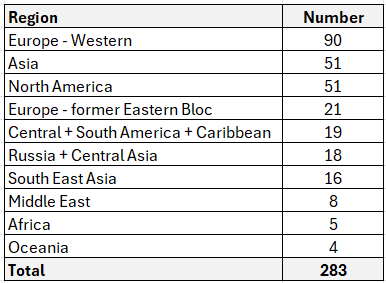
 The Distribution. Of the ~280 facility sites included on this list, approx. 7% distributed globally remain uncertain. These locations (n ≈ 20) originate from reports that provide country-scale tabulations, but for which the location of the sites can’t be corroborated from other sources (So: as example, a combination of publications may indicate that 8 mercury cell chlor-alkali facilities were built and operated in Sweden, but review of other reports, conference proceedings and publications only confirm locations for 5 of those facilities). In these instances, the numbered placeholders are retained and counted, while recognizing that the report from which the tabulated listing originated may have been in error. Likewise, there are without doubt other facilities that were built, operated and decommissioned without leaving a public record. Corporate re-organizations – in all their mergers, consolidations, spin-offs, closures and renamings – are purposeful, after all, and whether intentional or no, the growth, pruning and abandonment actions of corporate egosystems serve to conceal historical records.
With respect to this re-organization process, here’s an example, if you’re interested, for one facility in Ontario, Canada from which the downstream First Nations communities (Grassy Narrows, in particular) are still acutely suffering the long term effects of site discharges from more than 50 years ago (1962 – 1975). Are any of the previous owners liable for long-term monitoring and management of the site itself? Yes. Are any of the previous owners currently liable for long-term human health impacts in downstream communities? No. Has the Ontario Provincial Government in Canada played a role in the past in limiting downstream corporate responsibility through Acts of Indemnity? Yes. Are they still prioritizing corporate indemnity over the health of First Nations members? Yes.
Likewise, here is an example (DRAFT) of this re-organization process for one U.S. corporation that operated a mercury cell chlor-alkali facility in the U.S. (1953 – 1985), as well as exporting the mercury cell technology to Mexico (1958 – 2006) and Nicaragua (1968 – 1979). In Managua they made such a God awful mess that they acutely poisoned many workers in the facility and rendered Lake Managua unable to be fished. The result? Take a look at the flow chart in this example (above) and answer for yourself how the h*ll you’d even begin to figure out how to request or demand or sue for or access what that corporation never provided for those workers or their families in the aftermath.
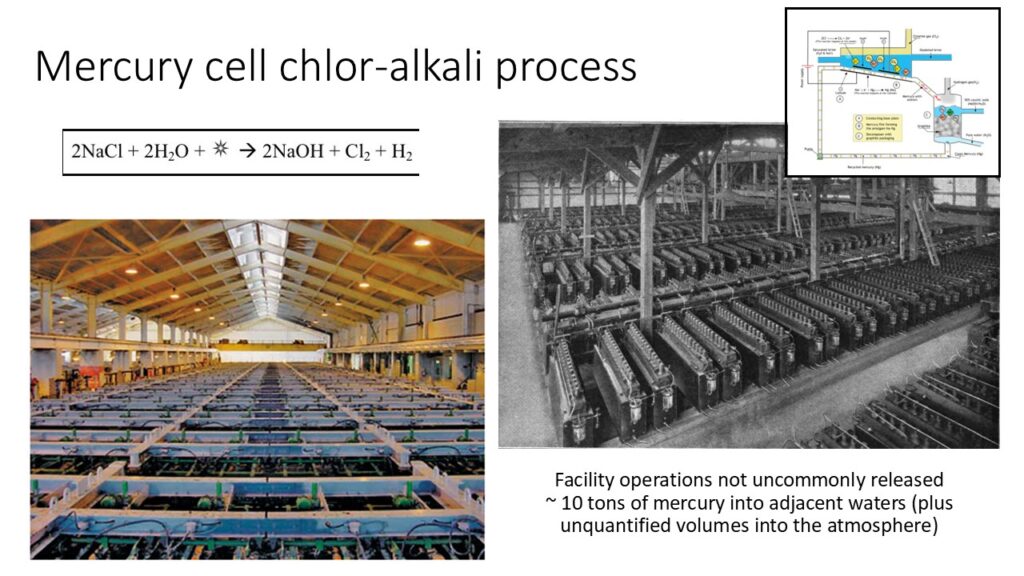
All information that was reviewed for this compilation is publicly available, either from actual libraries or via the Interwebz. Nothing fancy to this – it was a list I started compiling over the years I worked on this industry and thought about what clean-up of these sites can or could or should look like. If you want to know more (than you ever wanted to know) about the chlor-alkali industry, here’s a start (TheLevelUp), although there’s all kinds of comprehensive info on-line also. In determining ‘how bad is bad’ for any of these locations, there is some excellent biogeochemical characterization work that can serve as a template for site evaluation – Muniz Araujo et al. (2019) is a very good example – as well as management guidance for risk reduction and remediation at these facilities. The scale of the mess created (not just) by this particular industry over the 20th century still horrifies me.
