
Keep walking it backwards until you see the big picture.
*

His first name?
Mr.
Coach
(The) Dean
Why did he move to Gainesville back in the day? I don’t know, but maybe for the teaching position at Lincoln High School.
Where was I a student in his class? Buchholz High School
What did he say? Many things, including clarifying in Civics that fire hoses can and do knock you off your feet.
What did I understand at the time? Not nearly enough.
What ball dropped several years after I graduated HS and left for college: Coach Hinton came to G’ville from Birmingham.
*click*
and so much of what’s come since.
May you be resting in peace, Teacher.
*
Amelia Isadora Platts Boynton Robinson – Born into this World: August 18, 1905/1911; Called Home: August 26, 2015.
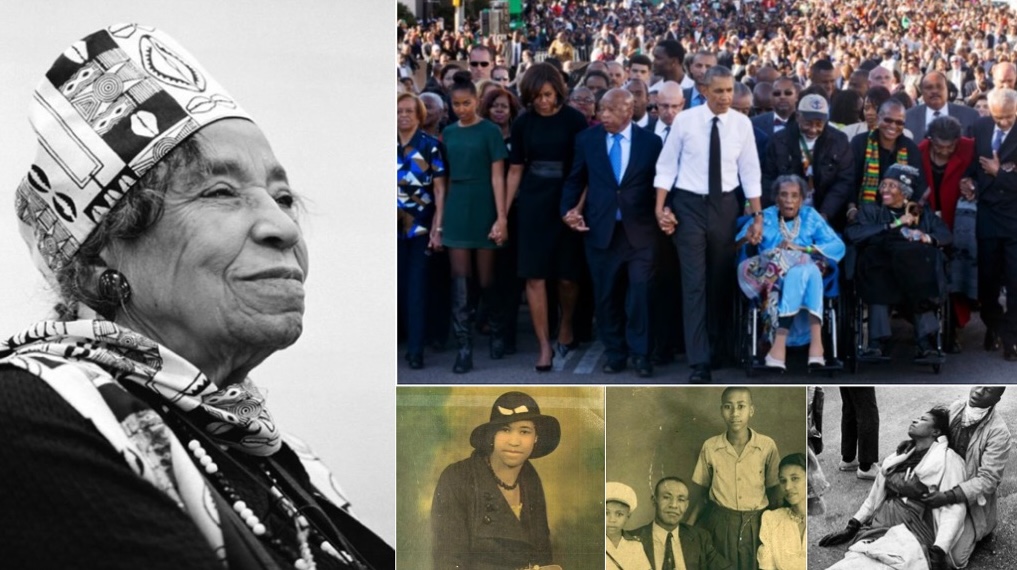 “Dr. Boynton was the straw that stirred the drink. She was a major catalyst in the Selma to the Montgomery march,” said Charles Steele, Jr., president and CEO of the Southern Cristian Leadership Conference (SCLC), the organization co-founded by the Rev. Dr. Martin Luther King, Jr. “She helped start and more importantly, bring attention to ‘Bloody Sunday’ (March 5, 1965) and her strength, courage and tenacity helped make Selma the historical icon that we know today. Dr. Boynton was to Selma what Rosa Parks (1913 – 2005) was to Montgomery,” Take a moment (or ALL the moments) to consider the arc of this woman’s life and her life’s work. [LINK]
*
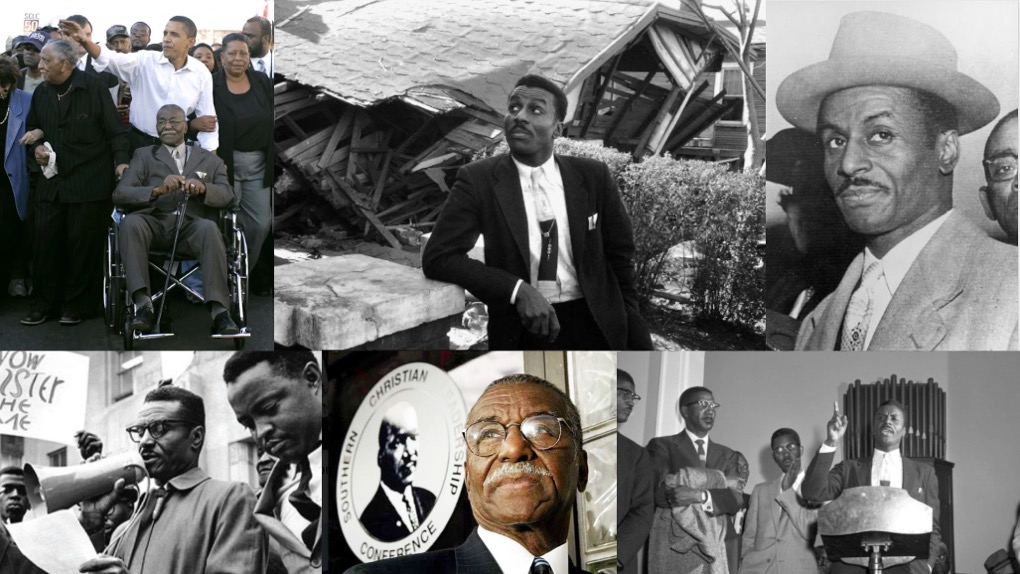
The Reverend Fred Lee Shuttlesworth (1922 – 2011)
There was the idea, there was a man, then there was God’s power, and all these come together. And then it’s time for a movement.
To begin with his stepping into the pastorship of Bethel Baptist Church in Birmingham in 1953 is to step into a flow that was already fully in motion. Start earlier: Born in Montgomery County, Alabama and graduating high school as the valedictorian of his 1940 class, The Reverend Shuttlesworth came to the pulpit of Bethel Baptist Church in Birmingham via night school, studying Divinity while working as a laborer first and then, during and after WWII, as a truck driver. Ordained in 1952, his first pulpit was in Selma. With a personality generally described in those years as combative or confrontational, Shuttlesworth was ousted from the First Baptist Church in Selma within a year, and moved with his family to Birmingham to assume the pastorate at Bethel Baptist. While he ultimately came to work well within the framework of non-violent civil disobedience in the struggle for Black civil rights in the South, his orientation was squarely toward the fight. The enemy in his specific fight: the pervasive brutality of the Birmingham police force toward the city’s Black citizens.
Reverend Shuttlesworth was a man of the doing: when Alabama state officials, in response to the success of the then ongoing Montgomery Bus Boycott (December 1955 – December 1956) shut down local NAACP branches as retribution, Shuttlesworth stepped forward and founded the Alabama Christian Movement for Human Rights (ACMHR). His reward for engagement in that breach? Sixteen sticks of dynamite that destroyed his home on Christmas night,1956. In a city that would come to be known widely by the mid-1960s as Bombingham, the Reverend, his family, his home, and his church were to become repeated targets of police-supported Klan violence over the decade that followed that evening.
Reverend Shuttlesworth was a man of commitment: during the 1961 Freedom Rides – organized to challenge Southern non-enforcement of the 1960 Supreme Court decision that ruled segregation of public buses unconstitutional – he played a significant role in mobilizing and organizing the clergy to assist the Freedom Riders. When the Riders were attacked in Anniston – following a police-backed Klan ambush in which the occupied bus was barricaded and then set on fire – deacons from his church rescued the Riders in a convoy organized by Shuttlesworth and brought them back to Bethel Baptist to recover. Where was Shuttlesworth on that day? Arrested for his actions to protect the fully law-abiding behavior of Riders whom law enforcement all the way up to the FBI were knowingly abandoning to Klan violence. Years later, Civil Rights organizer Diane Nash (b. 1938) would write of that time and that place and of the commitment required to exact social change as being buoyed and reinforced by Shuttlesworth: “I think it was important – for me, definitely, and for a city of people who were carrying on a movement for there to be somebody that really represented strength, and that’s certainly what Fred did. He would not back down, and you could count on it. He would not sell out, [and] you could count on that.”
Reverend Shuttlesworth was a man of vision: In 1963, he persuaded the Reverend Martin Luther King Jr. and the Southern Christian Leadership Conference (SCLC) – the newly formed faith-based social justice organization of which Reverend King was serving as the first President – to bring the civil rights movement to Birmingham. Shuttlesworth’s goal: to ‘shake the country.’ Later that year, when the Birmingham Police Commissioner responded to the SCLC-organized non-violent Children’s Crusade by unleashing police dogs, turning fire hoses on the demonstrators, and jailing more than 2,500 people, including children, the images of that Supremacist attack received international media attention and forced President John Kennedy to declare the struggle for civil rights a national moral emergency. Shuttlesworth, himself, was hospitalized with chest injuries during that Crusade after taking the full force of a high pressure fire hose that pushed him down a stairwell and into a wall. The Police Commissioner, alerted that Shuttlesworth had been transported to a hospital, wished publicly that “they’d carried him away in a hearse.” The following year (1964) the U.S. Government passed the Civil Rights Act, effectively (on paper, at least) ending legal segregation of public facilities in the United States. Across that Era – with the Civil Rights Act (1964) landing first, then followed by the Voting Rights Act (1965) and the Fair Housing Act (1968) – the country indeed shook. The Reverend Fred Lee Shuttlesworth, described by Reverend King as “one of the nation’s most courageous freedom fighters”, stayed steady as in his resolve and never even trembled.
*
Mary Jane McLeod Bethune (1875 – 1955)
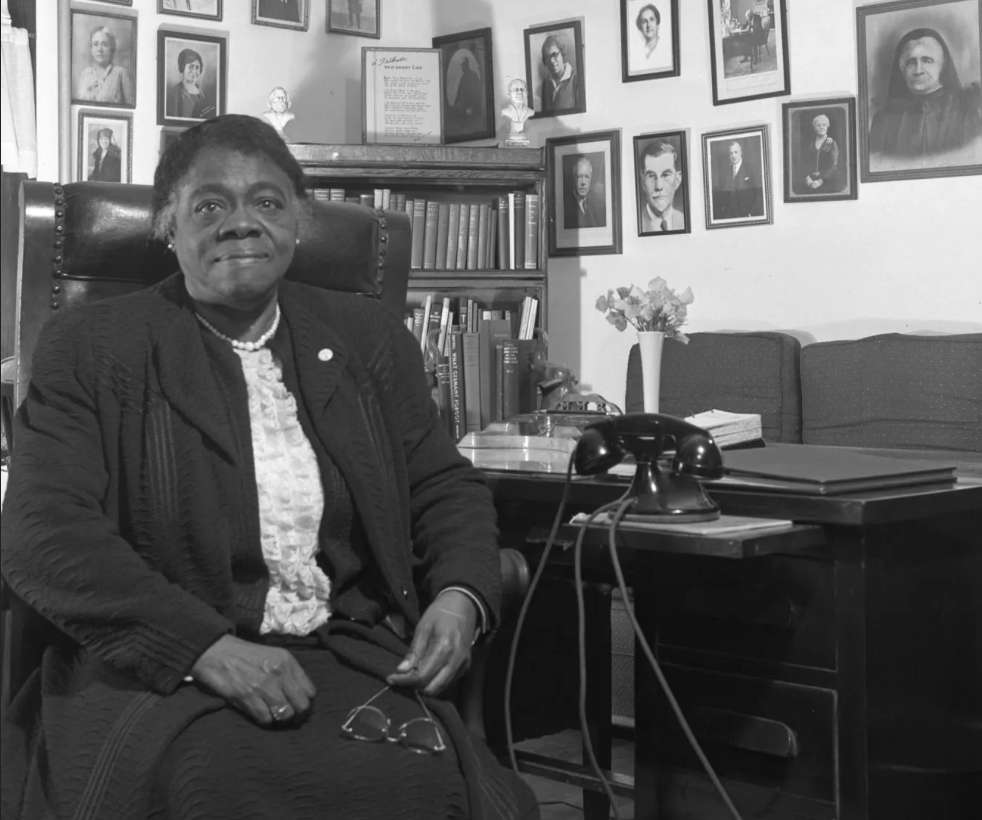
I leave you to love. I leave you to hope. I leave you the challenge of developing confidence in one another. I leave you a thirst for education. I leave you a respect for the uses of power. I leave you faith. I leave you racial dignity. I leave you a desire to live harmoniously with your fellow men. I leave you, finally, a responsibility to our young people.
In her remembering, her drive for education caught flame as a child: going with her mother to work in the fields of the people who had previously enslaved her mother’s family, she picked up a book in their childrens’ play house. The White Supremacist response was instinctive and engrained, funneled down through time and tradition into the mouthpiece that is always the current generation’s offspring: “Put down that book”, she recalled being scolded by one of that family’s children – “you can’t read.” In the parlance of today and knowing full well that Mary Jane McLeod was entirely too well brought up to have ever uttered these words outloud, her silent response might be paraphrased along the lines of: “f*** that noise.” She had life’s work to do.
In 1886 at age 11 she began attending school. The one room schoolhouse available to her was five miles from her home, and she walked it. Not all of her siblings were able to attend with her, so in the evenings she taught them what she’d learned that day. Learn, teach, learn. Learn, learn, learn. Through support of the Presbyterian church she continued her education and by 1895 had completed her high school and then her college equivalency. Her mission with ever increasing clarity: education of girls on matters both domestic and political. Education was the path forward and that path would lead ultimately to self-sufficiency and to freedom for Black communities.
In 1904, she and her husband brought that mission to NE Florida, the region along the St. John’s River having drawn a large Black community in the building of the Florida East Coast Railway during the decade preceding. They arrived first to Palatka and then, on her own, Mary McLeod Bethune moved on to Daytona Beach. Within five years in Daytona Beach, she had founded the Educational and Industrial Training School for Negro Girls. Beginning with 6 students and that slow, steady and unrelenting effort to expand the school offerings and secure the always needed materials and funds, by 1930 her vision had grown to an enrollment of ~ 1000 students and a manifestation as the first Black post-secondary school in Florida. By 1941 the Institute had achieved a four-year curriculum and been awarded full academic accreditation. In 1943, and in culmination of her long years as the Institution’s President – standing sometimes in literal direct defiance of the ever-angered and always encroaching Klan – Bethune-Cookman College graduated its first Black students in Liberal Arts and Teacher Education.
The list of firsts in her professional accomplishments is a testament to her skills and her determination in the face of the relentless uphill climb that this country demands of Black women with vision. In 1911, with the goal of providing training for the School’s student nurses, she opened the first Black hospital in Daytona Beach. The McLeod Hospital, named after her parents, pointedly employed both White and Black physicians. Within that decade she was also responsible for cracking open accessibility to the town’s (White) library – resulting in the state’s first (and at the time, only) library serving Black patrons, and, concerned by the absence of safe, available housing for Black residents in the Daytona area, leveraging her status as Training School President to remedy that lack for her students. As a result of that effort, she was appointed to the city’s housing board.
By 1928, her influence reached the national stage and she was invited, first by Coolidge, to attend the Administration’s Child Welfare Conference and subsequently by Hoover to an appointment at the White House Conference on Child Health. Under Roosevelt, McLeod Bethune was appointed to a staff position on the National Youth Administration and within two years, rose to serve as Director of the Division of Negro Affairs within this program, becoming the first Black female division head within the Works Progress Administration (WPA) and the highest ranking Black woman in the Federal Government. In the capacity afforded to her through this position, she ensured Black colleges participated in the Civilian Pilot Training Program (1933 – 1944), thereby graduating some the nation’s first Black pilots who would shortly serve with distinction in WWII. Throughout the Roosevelt years (1933 – 1945), McLeod Bethune served as an adviser to the President on strategies for increasing minority and women’s enfranchisement and in this capacity, was responsible for the racial integration of officer candidates for the U.S. Women’s Army Corps. During these decades of her public service career, McLeod Bethune founded the National Council of Negro Women (1935); was the sole appointed woman of color at the 1945 founding Conference of the United Nations; and was elected as vice president of the NAACP, a position she held until her death in 1955.
As testament to the steepness of that required uphill climb, it took two decades for a public monument to appear in her honor: the Mary McLeod Bethune Memorial, installed at Lincoln Park in Washington D.C. This memorial holds the (dubious) distinction of representing the first monument installed in a public park in the District of Columbia to honor an African American or a woman. And lest the steepness of that climb and the enduring invisibility of Black talent, effort and vision to this Nation be at all under-seen, ignored or negated, it was in 2022 that McLeod Bethune became the first Black American to be honored with a statue in the National Statuary Hall Collection at the U.S. Capitol. 2022. Yes. Read that again. 2022. In a statuary collection that was established by an Act of Congress in 1864. Yes. 1864. Read that again too.
Let her works bring her praise, encourages Proverbs. And so as testament to her life’s work in pursuit of Black educational and professional opportunity, there are schools across the nation that now bear her name: in Los Angeles, Moreno Valley and San Diego (CA); in Chicago (IL); in Dallas (TX); in Phoenix (AZ); in Jacksonville, Ft. Lauderdale, Palm Beach and Miami (FL); in Minneapolis (MN); in Atlanta, Folkston and College Park (GA); in Philadelphia (PA); in New Orleans (LA); in Rochester (NY); in Cleveland (OH); in Boston (MA); and in Milwaukee (WI). For her talent, effort and vision, let us continue to praise her too. Mary Jane McLeod Bethune did not come to play.
*
Maya Cade and the Black Film Archive
 In June, 2020 – back there in the depths of COVID lockdown when we were all trying to sort out what the h*ll was going on and for how long was it all going to continue – Maya Cade started building the archive of Black cinema that she’d always wanted to have had. The Black Film Archive spans the decades of the 20th century and contains 200+ publicly available films with Black leads and/or Black production teams that orient toward Black audiences. The Archive, as she has created and describes it, is a living register of Black cinema.
Watch movies. Think about movies. Consider perspectives in movies. Never lose track of who’s interior thoughtreel you have settled in to quite literally engage with as projection. Pay attention to who’s there. Pay extra attention to who isn’t.
Ms. Cade is currently a scholar-in-residence at the Library of Congress and has been awarded distinction by the New York Film Critics Circle and the National Society of Film Critics. In 2026, she became President and owner of the Black film distribution company, Milestone Films.
*
Daisy Lee Gatson Bates (1914 – 1999)
 Activist, journalist and determined guide, protector, strategist and mentor for the Little Rock Nine. In her autobiography – The Long Shadow of Little Rock (published in 1962) – she wrote: “As President of the NAACP State Conference of Branches and as the publicized leader of the integration movement in Arkansas, I was singled out for ‘special treatment.'”
That special treatment: Two flaming crosses were burned on she and her husband’s property. The first, a six-foot tall gasoline-soaked structure, was accompanied by a scrawled hissy fit of a Supremacist tantrum, exhorting Bates and her husband to “GO BACK TO AFRICA! KKK.” The second was placed squarely against the front of their house before it was lit. Discovered by a neighbor, it was extinguished before significant damage occurred.
What had she done to deserve this ‘special treatment’? “Any time it takes eleven thousand five hundred soldiers to assure nine Negro children their constitutional rights in a democratic society, I can’t be happy”, she wrote. She walked a straight line through the Desegregation Crisis with a focus on protecting and supporting those nine young people and their families. That’s what she did. [LINK]
*
Anna Arnold Hedgeman (1899 – 1990)
 The Organizer. That Ms Hedgeman was the only woman on the executive planning committee for the 1963 March on Washington is both a testament to her skills as an organizer and an embedded question to consider. It was at the insistence of Ms Hedgeman – protesting the minimal recognition of women as heroes of the civil rights movement – that Daisy Bates took the stage that day in D.C.
Ms. Hedgeman was the first Black woman to graduate from Hamline University (1922) and the first Black × woman to serve on a New York City mayoral cabinet (1954-1958). She made her career as an educator, an organizer, an activist and an advocate for women’s rights and opportunities. A woman of faith, she worked for the Black YWCA in four states, ultimately running the organization’s Harlem presence. During the Depression she was a consultant for the Emergency Relief Bureau of New York, protesting the near-enslavement conditions of Black women working in domestic service in the City. During WWII, she worked as a civil defense official, advocating for Black workers in war industries. Following the war, while serving as assistant dean for women at Howard University, she worked to pass legislation advocating for fair employment practices. In 1966, she was the first executive vice president of the newly formed National Organization of Women (NOW) and the first chair of NOW’s Task Force on Women in Poverty.
As a child, her father would ask each night: How have you been useful today? For yourself and for life. How have you been useful today?
*
Zora Neale Hurston (1891 – 1960)
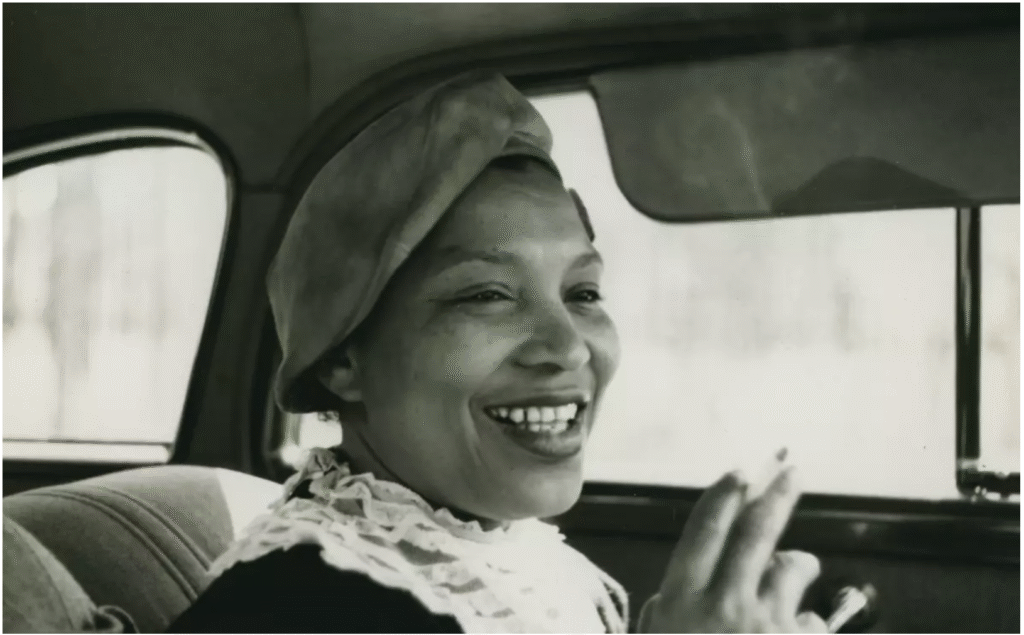 Describing her childhood, she wrote: “I was born in a Negro town. I do not mean by that the Black back-side of an average town. Eatonville, FL is, and was at the time of my birth, a pure Negro town – charter, mayor, council, town marshal and all.” Describing herself in her glory, she wrote: ““When I set my hat at a certain angle and saunter down Seventh Avenue, Harlem City feeling as snooty as the lions in front of the FortySecond Street Library … the cosmic Zora emerges. I belong to no race or time. I am the eternal feminine with its string of beads.”
In a writing career that spanned three decades and from which recently discovered works are still being brought to print, Zora Neale Hurston published four novels, at least two collections of folklore and non-fiction, an autobiography, and more than fifty articles, short stories and essays. She studied anthropology and ethnography at Barnard College – arriving as the only Black student on campus after having received her Associates degree from Howard University – and in 1928 became the first Black woman to graduate with a degree from Barnard. Hurston’s work as an anthropologist – born of her focus on combating the idea that Southern Black people had no culture – was as significant as her literary output. Traveling alone through the South in the 1920s, she collected songs, folktales and life stories from Black communities. At a time when anthropology was viewed as a study of the other, and when the Black literary authentic was equated with urban, Hurston grounded her work in the rural lives of those with whom she’d grown. In 1935 she published Mules and Men, an anthology of Black folklore collected from within the lumber camps of North Florida. This work, wrote one of her later biographers, argued for the re-evaluation of the Black folk aesthetic on its own terms, testifying to Zora Neale’s belief that “folk were creating an art that didn’t need the sanction of Art to affirm its beauty.”
In 1937 she published Their Eyes Were Watching God, a deeply situated telling in both place and time that begins and ends in Eatonville. The story? Janie comes home. This sentence sets the stage: “The women took the faded shirt and muddy overalls”, wrote Hurston, “and laced them away for remembrance. It was a weapon against her strength and if it turned out of no significance, still it was a hope that she might fall to their level some day.” And home from where? From Belle Glade. This sentence tells the history: in 1928, the San Felipe Segundo hurricane hit South Florida and overtopped Lake Okeechobee near Belle Glade. The flood that followed may have killed more than 2500 people, the majority of whom were Black migrant farm workers, the majority of whom were never identified. After the hurricane, Black survivors of the flooding were forced to recover the bodies of those killed: white flood victims were buried in coffins in local cemeteries, Black flood victims were bulldozed into unmarked mass graves or stacked in piles by the side of the road and burned. The officials in charge of the recovery effort ordered that food would be provided only to those who worked. If you refused that work? If you refused the indignity of that official denial of proper burial for Black victims of that storm? You could be shot. Hurston spent time in Belle Glade while writing this work. You can trust that this local history and its attendant horror were known to her.
Zora Neal Hurston’s life – as she both chose and was simultaneously constrained to live it – could and does fill volumes. I Love Myself When I Am Laughing And Then Again When I Am Looking Mean & Impressive – a 1979 anthology of her works – is one such volume and a very fine place to start. Alice Walker’s (b. 1944) Looking for Zora (1975) – a tightrope of icon praise and utterly uncomfortable reality – is another.
*
Gilbert Scott-Heron (1949 – 2011)
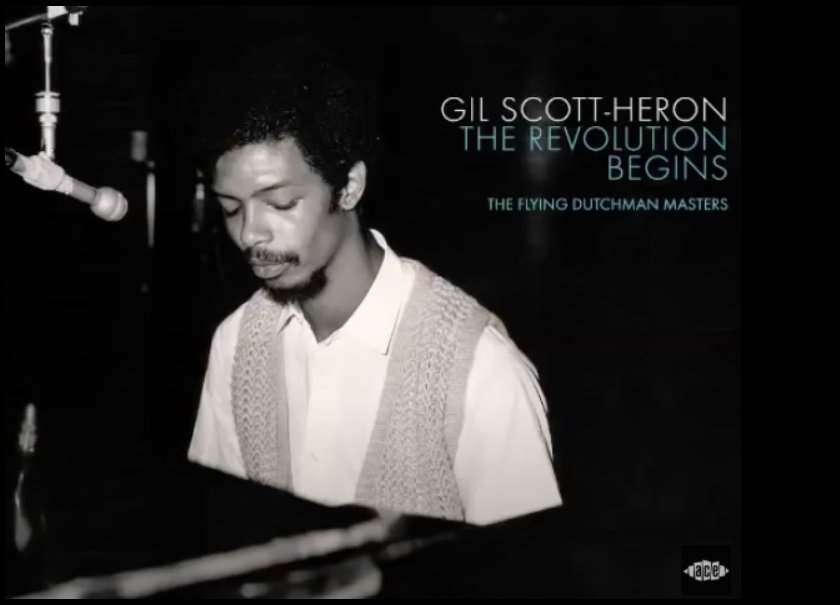 How he described himself: a Black man dedicated to expression of the joy and pride of Blackness. How the media describes him: a poet, a jazz musician and a rap pioneer. Born in Chicago, IL, he was raised mostly by his grandmother, Lily Scott, in Lincoln, TN. How he described her: “absolutely not your mail-order, room-service, typecast black grandmother.” A civil rights activist and musician, she bought him a piano and introduced him to the writings of Langston Hughes. He wrote his first volume of poetry at age 12. When Lily Scott died, Gil Scott-Heron moved to Harlem to live with his mother. His writing talent recognized, a teacher opened a place for him in a system that he allowed to serve his needs for a time: public high school to private high school to Lincoln University (where Langston Hughes had also studied) for one year before dropping out in 1968 to write and publish his first novel. It was at Lincoln U that he met the flute player Brian Jackson, his future and long-term musical collaborator. While his work was often overtly political he leaned into the improvisation and the exuberance, reminding his audience that his goal was broader than ‘simple sloganeering’.
This post is not so much to lionize him – his demons took him down their own series of twisting paths that wind beyond the possibilities of this short form here to grapple with – but to tune your (my, our) thinking/feeling/listening to a time and a place that crossed and crystallized into the person of Gil Scott-Heron; the Black man who created this. Settle in and really listen.
***
You will not be able to stay home, brother
You will not be able to plug in, turn on and cop out
You will not be able to lose yourself on skag
And skip out for beer during commercials, because
The revolution will not be televised
The revolution will not be televised
The revolution will not be brought to you
By Xerox in four parts without commercial interruptions
The revolution will not show you pictures of Nixon blowing a bugle
And leading a charge by John Mitchell, General Abrams, and Spiro Agnew
To eat hog maws confiscated from a Harlem sanctuary
The revolution will not be televised
The revolution will not be brought to you by the Schaefer Award Theatre
And will not star Natalie Woods and Steve McQueen or Bullwinkle and Julia
The revolution will not give your mouth sex appeal
The revolution will not get rid of the nubs
The revolution will not make you look five pounds thinner, because
The revolution will not be televised, brother
There will be no pictures of you and Willie Mae
Pushing that shopping cart down the block on the dead run
Or trying to slide that color TV into a stolen ambulance
NBC will not be able predict the winner
At 8:32 on report from twenty-nine districts
The revolution will not be televised
There will be no pictures of pigs shooting down brothers on the instant replay
There will be no pictures of pigs shooting down brothers on the instant replay
There will be no pictures of Whitney Young
Being run out of Harlem on a rail with a brand new process
There will be no slow motion or still lifes of Roy Wilkins
Strolling through Watts in a red, black, and green liberation jumpsuit
That he has been saving for just the proper occasion
“Green Acres”, “Beverly Hillbillies”, and “Hooterville Junction”
Will no longer be so damn relevant
And women will not care if Dick finally got down with Jane
On “Search for Tomorrow”
Because black people will be in the street looking for a brighter day
The revolution will not be televised
There will be no highlights on the eleven o’clock news
And no pictures of hairy armed women liberationists
And Jackie Onassis blowing her nose
The theme song will not be written by Jim Webb or Francis Scott Keys
Nor sung by Glen Campbell, Tom Jones, Johnny Cash
Engelbert Humperdinck, or The Rare Earth
The revolution will not be televised
The revolution will not be right back
After a message about a white tornado
White lightning, or white people
You will not have to worry about a dove in your bedroom
The tiger in your tank, or the giant in your toilet bowl
The revolution will not go better with Coke
The revolution will not fight germs that may cause bad breath
The revolution will put you in the driver’s seat
The revolution will not be televised
Will not be televised
Will not be televised
Will not be televised
The revolution will be no re-run, brothers
The revolution will be live
*
Purvis Young (1943 – 2010) + The Overtown Neighborhood, Miami, FL (1896 – now)
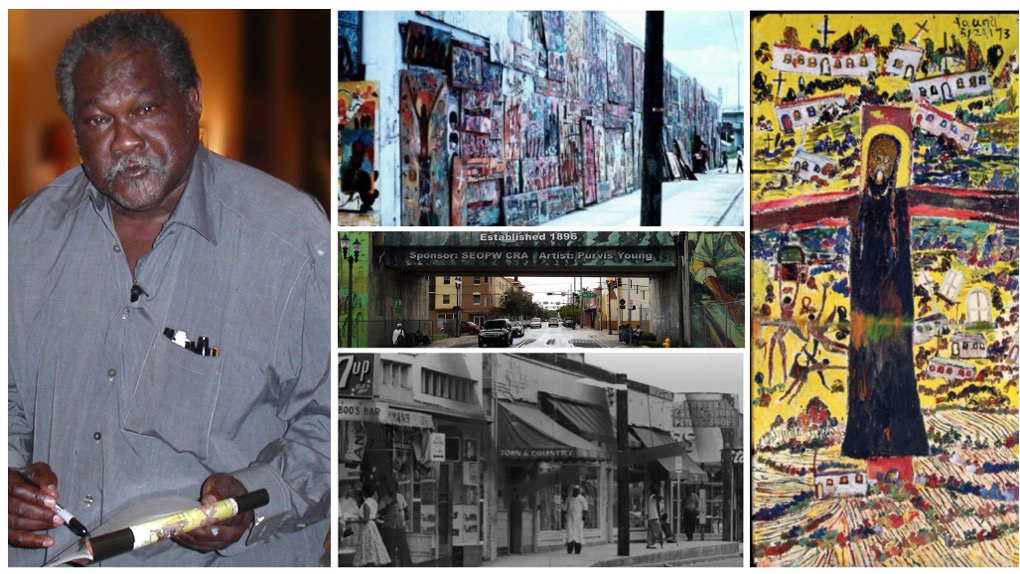 Established with the founding of the city of Miami and the recruitment of Black workers from other Southern states and the Caribbean to extend the Florida East Coast Railway line, the Overtown neighborhood was delineated in the area west of the Florida East Coast Railroad tracks. By 1930, the majority of the almost 30,000 Black residents of Miami – at the time about 25% of the city population – lived in this small area outside of the downtown. The mandated and enforced confinement and separation based on race that Black Overtown residents endured during this period persisted legally into the second half of the 20th Century through weight of policies and practices including redlining, restrictive covenants, racially biased local zoning, segregation in schooling and other public services, and racial terror and violence enacted by White people in South Florida to enforce social hierarchy and residential, social and commercial segregation in Miami (as well as elsewhere). As the result of this legal (de jure) and socio-cultural (de facto) segregation, while the Overtown neighborhood became the commercial and cultural center of Black Miami, residents within the neighborhood were forced to contend with substandard housing, significant overcrowding, rental price gouging, and insufficient municipal services, including unpaved roads, inconsistent water and sanitation service and unreliable trash collection.
But still, wrote poet + Civil Rights activist, Maya Angelou (1928 – 2014), like air, I’ll rise.
During the 1940s – 1950s, Overtown was a thriving Black district, with Black entrepreneurs and professionals owning businesses, churches, clinics, bars, hotels, music halls, restaurants and theaters, including the Lyric Theater. In the segregated Jim Crow era of the early 20th Century, the Lyric hosted world-famous Black performers and poets, including Ella Fitzgerald, Billie Holiday, Ray Charles, Nat King Cole, Count Basie, and Langston Hughes. Many of these singers and musicians would perform in segregated (Whites only) nightclubs and theaters in other Miami districts and then come to Overtown to perform encore shows and to eat, sleep and relax. Overtown’s 2nd Avenue Corridor of music halls, restaurants, hotels, and entertainment venues came to be known as ‘Harlem of the South’ and Black talent was celebrated in the Rockland Palace, the Ritz Theater, The Harlem Square Club, Clyde Killens’ Pool Hall, Odell’s Bar & Grill, and The Mary Elizabeth Hotel & Birdland Fiesta. The spirit of (absolutely necessary) entrepreneurship in Overtown was also manifest in the neighborhood district known as Good Bread Alley. Located between 12th and 14th Street (N-S) and 3rd and 4th Avenue (E-W) and named for the aroma of the freshly baked cornbread and johnnycake that residents here sold from their front porches, Good Bread Alley was a locals-only Overtown institution.
In the 1960’s, as the Miami cornerstone of the federally-funded Urban Renewal program, the I-95 and 395 Expressways were built through downtown Miami. While the existing and abandoned rail corridor that ran along the eastern boundary of Overtown was initially proposed as the through-town routing for I-95, city planners chose instead to shift the routing several blocks to the west and through the center of Overtown, razing older residential streets in the neighborhood including Good Bread Alley. Taken together, the combined I-95 and I-395 highway construction ultimately displaced 15,000 residents and demolishing 40 blocks of housing as well as a significant portion of Black Miami’s main business and entertainment district. Over the 10+ years of housing clearance and Urban Renewal highway construction in Overtown, the once-thriving community lost almost 75% its population.
During neighborhood demolition for the highway construction, a local resident, Purvis Young , began his own protest using house paint and plywood to create hundreds of murals across the houses and buildings in Good Bread Alley. Painted principally over the years 1972 – 1975, Mr. Young’s work – clearly visible from the multi-lane I-95 – stood as a loud and locally fueled protest against the demolition of his neighborhood. The majority of the panels in the Good Bread Alley Project were destroyed in 1975 when the remainder of the buildings on 14th Street were condemned & demolished to make way for new Federally-funded public housing. A self-taught artist, Mr Young continued making art, creating complex painted works on paper, concrete, metal and found objects.
If you want to see Mr. Young’s mural in place and in time, click here. Sit for 15 minutes and watch Ron Williams 1972 film” The Matter With Me”. There starting at minute 11 is Mr. Purvis’ work. But still like air, wrote the poet, I’ll rise.
*
Bessie Stringfield (1911 – 1993)
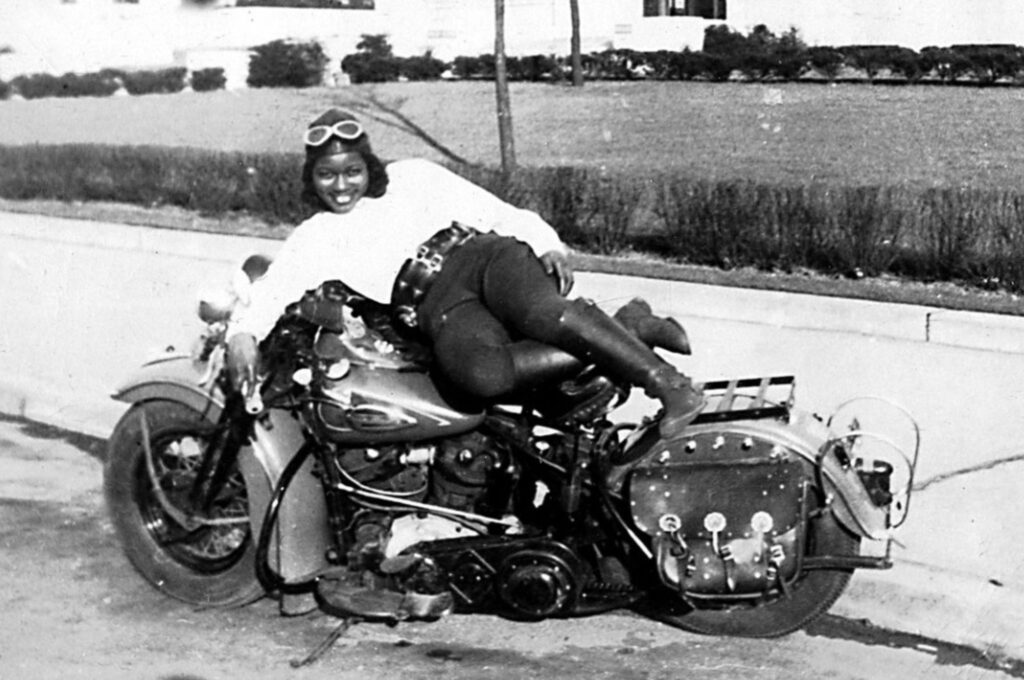 There are stories. And stories within stories. And with any one of them, let the details stop you in your tracks. Here’s one: Bessie Stringfield rode her motorcycle across the U.S. 8 times in the 1940s. Here’s a second: She did it alone. Yeah. She rode alone across rural America during (the never-ending) era in which nothing about her very Being – Black, female and extraordinarily talented at an activity that left her open to the hostility of those whose gut response to Black × female × talented was to threaten violence – was safe. She entered flat-track races disguised as a man and was often denied the prize money if and when it was revealed that a woman had beat the men. If you (meaning, you, me, any of us) have never experienced the world with the background volume turned all the way up on the danger, it can be hard to feel the bravery in this act. But right there it was.
Born in Kingston, Jamaica or perhaps Edenton, NC and possibly orphaned in Boston at age 5, she may have been adopted by an Irish couple through unclear circumstances. By age 16 she had worn down the concerns of her mother and gotten her first moto. By age 19, Stringfield hit the road: flip a penny onto a map and figure out how to ride there, this in the many decades prior to the National Highway System and deep in the early 20th century arc of racial segregation that blocked her entry into hotels, places to eat and garages for repairs. Her solution: stay with the Black folks she met, sleep in fields when needed, and fix her own breakdowns. In so doing, Stringfield became the first Black woman to ride a motorcycle in all lower 48 states.
In 1939 after her adoptive mother passed, she left Boston and moved to Miami. Working as a registered nurse, she continued to ride: serving as a dispatch rider between U.S. army bases during WWII – one of few civilian dispatch riders and the only woman in that corps; angering and then impressing the h*ll out of Miami police, the Chief abruptly curtailing the harassment she’d been enduring when she showed him how to put a motorcycle through its paces, and happily scandalizing congregations – riding one of her many Harleys to church well up into her 70s. A devout believer in Jesus Christ, she kept her eye on the Lord and the Lord kept his eye on Bessie. Over 63 years of riding, she was only injured once. Stringfield – known around town as either BB or The Queen of Miami – owned 27 Harleys over the years, almost all meeting her two central criteria: they had to be new and they had to be blue. Folks around Miami knew her best by the poodles she trained to ride with her in city parades. She’d carried and lost three babies with her first husband and poured all that love out onto those favorite dogs.
Stringfield passed in 1993. In 2002, she was posthumously inducted into the American Motorcyclist Association (AMA) Hall of Fame, with the AMA instituting the Bessie Stringfield Award to honor women who are leaders in riding. “Way out front, looking sharp, and breaking expectations” is how they described her. How she described herself: a woman of deep faith. When asked how she learned to ride – way back in the day when there was nobody to help her learn, she said: “”I wrote letters to the Man Upstairs. I put the letters under my pillow and He taught me. One night in my sleep, I saw myself shifting gears and riding round the block. When I got out on the street, that’s just what I did!”
*
Misty Copeland (just doing her thing) and Anne Raven Wilkinson (1935 – 2018)
 In 2015, Misty Danielle Copeland (b. 1982) became the first Black woman promoted to principal dancer in the 75-year history of the American Ballet Company. For an art form in which the pinnacle of expression for female-bodied dancers has always been willowy and white – light enough to lift and pale as a sleeping Disney princess – Ms. Copeland has elegantly and powerfully shifted the frame. “When it comes to classical dance” she’s said, “the thing that’s kept it alive and relevant is the technique.” The focus, as she’s meant, belonging on the form and its expression, not on the projections of the Great White We for who *should* be filling that frame.
Ms. Copeland shares it back and shares it forward: a book in 2022 celebrating her late friend and mentor, Anne Raven Wilkinson, and a second, honoring the Black ballerinas who came before her. Ms Wilkinson was the first Black woman to dance with a major ballet company in the U.S., signing in 1955 to tour with the Ballet Russe de Monte Carlo. Although lighter-skinned and encouraged to wear pale makeup onstage to de-escalate the potential for the harrowing harassment she received while the company toured in the South, Ms. Wilkinson always refused to hide her race. She danced with the Ballet Russe for 6 years before that harassment escalated dangerously to the point that she left the company and briefly stopped dancing altogether. After several years away from the art form she loved, she returned to dance, first with the Dutch National Ballet and then, at age 40, joining the New York City Opera.
Misty Copeland also shares it forward: two children’s book to date on her love of dance – one, her own story of discipline, perseverance and joy, and the second, a story for anygirl with a desire to express herself through dance – the story celebrating and centering Blackness in the telling, representation mattering deeply for children in the books they hold. In honoring and centering what her art form has always *asked* previously to be hidden – the magnificence of the strength that is needed to make grace manifest – Ms. Copeland is changing the very form of that most classical of artistic expressions: the jaw-dropping, gravity-defying gorgeousness that is ballet.
*
Lorine Alexander (1922 – 2007)
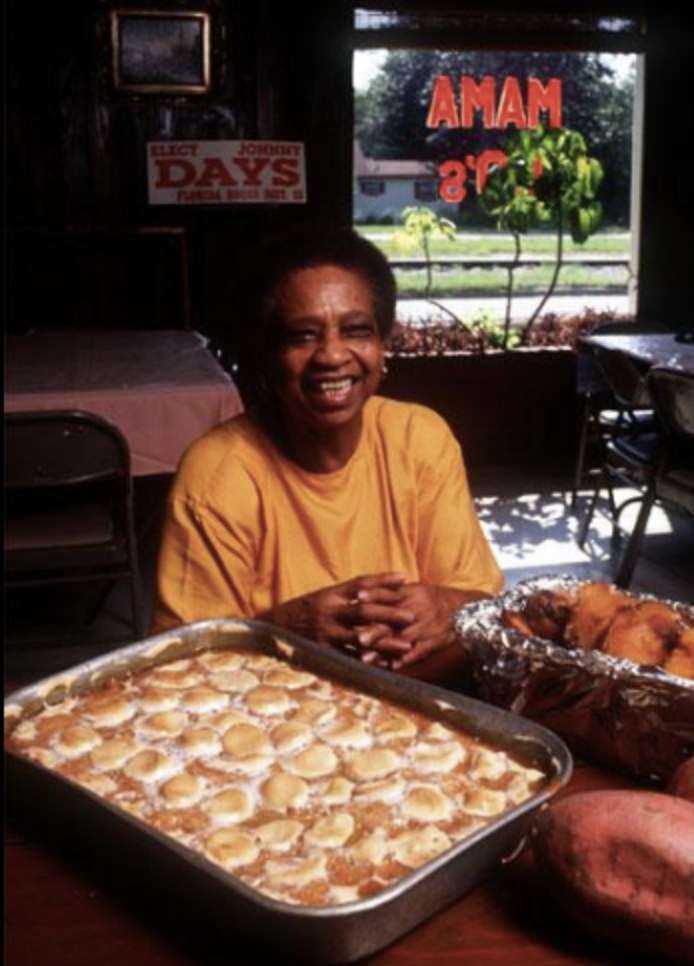 Mama Lo. Gainesville, FL. This is about food. Sort of. But also entirely. Coming or going on University Avenue in G’ville, you’d cross the railroad tracks at 6th Street that – as a White kid growing up in that town in the 1970s – 1980s – made no sense at the time. If you’re wanting to understand that squalling dissonance that is cultural amnesia – history rolled somehow like pastry dough – those seams of richness and of evil all folded in and worked through and the finished product offered back to you as proof somehow that we’re all equal now. But we’re not. If you’re White and growing up in G’ville on the West side of town, it was possible to believe that town stopped somewhere west of 6th Street. Or not precisely, because the downtown library was east of there, but University Avenue was a corridor – a straight line that unrolled right on through. If you’re reading this, you know where it is going: at some point if you’re paying attention at all the dime’s gotta drop. At some point as a young adult, late in high school, after a childhood spent riding as a part of court-mandated desegregation and that busing all criss-cross about that 6th Street line – you look at that pastry thing on your plate and you….you what? You get on your bike and you start riding around. And you start finding what you’re missing.
Now, this isn’t at all to say, of course, that what YOU are missing is also in any way missing YOU – a White kid on a bicycle just riding around – but understanding how your hometown works (or doesn’t) has started feeling personally important for reasons that don’t quite make sense to you yet. So you ride around. You turn north on 6th Street one day and you find Mama Lo’s Restaurant. And standing there with your bike on the east side of 6th Street wondering whether it might be ok to come back and go inside for lunch sometime, you crash headlong right into the blindness in your own mental map: *who comes all the way out 6th Street to eat here?*
Um. Yeah. And your gravity is seriously f*ckin’ off, right? You, way out there on the west side of town might as well be Pluto in the actual ordering of things. And this vertigo that you’re coming to recognize if not yet entirely understand might evoke that old slapstick image of stepping on the rake head and watching the handle rise right up to smack you square between the eyes, if this were funny, of course. But it’s not. And Lorine Alexander – Mama Lo – ran a restaurant for 45 years on 6th Street in Gainesville, FL – right west of the Pleasant Street and Grove Street Neighborhoods and serving up all that delicious that you come to discover – and nobody that you’re growing up with over there on Pluto knows or sees a thing. And there’s not a single bit of it, of course, that Lorine Alexander did for me or for my benefit – she ran that restaurant and put all 4 of her kids through college on what she made – and gravity out there on my westside Pluto had little or no impact on her 6th St. world, but I will regret for the rest of my life that when she closed Mama Lo’s in the mid-90s I wasn’t somehow able to lean my little Pluto weight into helping commemorate who she was and what she made and offered up. That space is an empty lot now and shouldn’t be.
*
The Black Press (the arc of the 20th century)
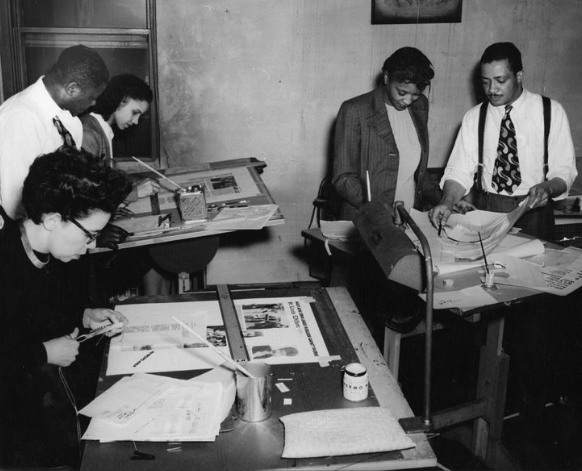 Chicago Defender, The Baltimore Afro-American, New York Amsterdam News, Pittsburgh Courier, Los Angeles Sentinel, Atlanta Daily World, The Norfolk Journal and Guide, The Philadelphia Tribune, Cleveland Call and Post, and Michigan Chronicle – In the lead-up to the US involvement in WWII, President Franklin D. Roosevelt was a propaganda machine, leaking big stories to favored reporters and encouraging coverage and access for writers from obscure journals who were technically ineligible for press credentials. In doing so, he was attempting to literally paper over who and what this flurry of self-serving reportage was obscuring: his government’s decision to embrace segregation in the military. Separating military men and women, including even the wartime blood bank, by race and frequently and purposefully placing Black enlisted soldiers in units under the command of Southern officers, the government ratified racial apartheid and introduced Jim Crow segregation into parts of the country where it had not previously been openly practiced. The Black Press, in response, tore him a new….
Black-owned newspapers across the country told the unflinching truth: that the Roosevelt government’s insistence on racial separation was of a piece with the “master race” theory that the U.S. was in the process of entering the war to destroy in Hitler’s Germany. This was ultimate hypocrisy practiced against U.S. citizens, wrote the Press, and Black men and women should be warned that this was not their war either to fight or to realize social progress within. The issue of officially permitted and practiced segregation in the military was not the first time The Black Press attacked institutional racism and would not be the last.
The desire to organize and speak as one voice during this period of wartime patriotic propaganda led the Editor of the Chicago Defender – the newspaper that the Military Intelligence Bureau referred to as “the most dangerous of all Negro journals” – to form The Negro Newspaper Publishers Association. When John H. Sengstacke, the editor of the Chicago Defender and first President of the Association, was summoned to Washington by the Attorney General, who threatened to his face to close all Black newspapers on charges of sedition, Mr. Sengstacke replied with a steady ‘knock yourself out’: “You have the power to close us down. So if you want to, go ahead and attempt it.” The AG turned on a (albeit, slow-moving, Federal) dime. Doors that were closed to Black reporters began to open and within a year, the first Black Press reporter was given a White House press pass. Within another year, FDR had died and the Black Press had emerged with a flex that both pushed and pulled the subsequent Truman administration toward taking policy action against segregation in both the military and civilian life. The Press, indeed, never sleeps, and as a force for channeled anger and truth, it is impossible to overstate the role that a free, focused and ferocious press plays in bending the long arc towards Democracy. If you’re interested in a great read about Chicago, The Defender and John H. Sengstacke, check this one out.
*
Charles “Teenie” Harris (1908 – 1998)
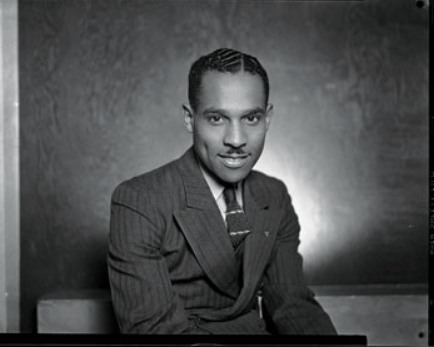 Inside/Outside; Ordinary/Extraordinary – his work is magnificent from any combination of cultural vantage point and perspective. Professionally, he was a (or THE) photographer for the Pittsburgh Courier, one of the nation’s preeminent mid-20th century Black newspapers. Beginning in the mid-1930s and continuing for more than 40 years, Mr. Harris photographed Pittsburgh’s Black community; in doing so, he created a deep, rich, resonant visual record of the lived experiences of that city’s Black residents. Although he also ran his own studio from which he worked independently as a photographer, he is most often memorialized as a photojournalist. His archive of 70,000+ images is a masterpiece; 57,492 (to date) of those images have been digitized and are available through the Carnegie Museum of Art. [LINK]
Mr. Harris was mostly self-taught and he kept it simple, working with a single camera type: a Graflex medium-format that is now held in the collection of the Smithsonian National Museum of African American History and Culture. His focus wasn’t on his gear, it was in his community: barber shops, front porch swings, breakfast counters, churches, tea rooms, dance halls, kids in comic book stands, baseball all-stars in the Negro League, birthday parties, pallbearers, folks leaning in style against those sweet wheels of the era on The Hill. His focus was also on the Black Brilliance that came to town: Lena Horne, Ray Charles, Duke Ellington, Cab Calloway. He almost never travelled outside his city. And why would he? The world came to him. His work was barely known beyond Pittsburg until after his death and he said he’d never understood the fuss anyway: to the kids in his town he was ‘Mr Camera Man’ – strolling with his own impeccable style – he understood that the glamour with the sweetest glow was a casual thing: you don’t need a dozen images all posed up and preening to see the spirit of someone. You just need to look right straight through the lens and see the people you know being who they are.
Spend some time if you have it looking through the archive: this is a Black community, centered up and shining through the lens of their photographer. The racist sh*tshow of the outer world is all there too: you can (and should) pay attention to what’s missing in these images of neighborhood life in this ‘progressive Northern city’, but hold both that horror and this joy that Mr. Harris recorded in your mind – one does not preclude the other. Take some time with this man’s legacy and let him help you learn how to see.
*
A. Philip Randolph (1889 – 1979)
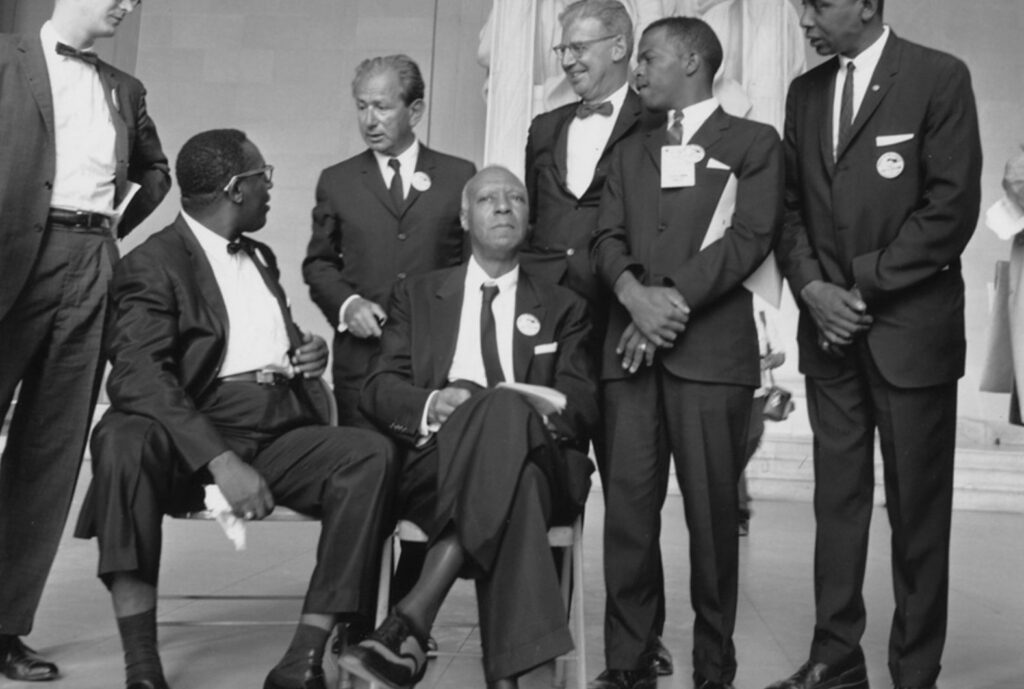 Front and center – In 1925 he founded the first successful Black trade union – The Brotherhood of Sleeping Car Porters. Does that sound straightforward? It wasn’t. It took more than 10 years for the Pullman Palace Car Company to recognize the labor rights of the Black porters who worked for Pullman and, in the process, an almost equivalent amount of time – working with organizers within the communities in which the porters and their families lived – to encourage the porters to believe in their rights to collectively bargain.
Born in Crescent City, FL and graduating high school at the Cookman Institute (now Bethune Cookman University, then the only academic high school in FL for Black students)) as valedictorian, A. Phillip Randolph left Florida for New York City in 1911 at 21. In 1917, he and a law student, Chandler Owen, with whom he’d begun what became a life-long friendship, started publishing The Messenger. Described redundantly as “one of the most brilliantly edited magazines in the history of Negro journalism” and “the most able and dangerous of all the Negro publications”, for the short arc of years in which The Messenger shone, the publication provided a platform upon which Randolph and Owen campaigned against lynching, opposed U.S. participation in World War I, and urged African Americans to fight for integration, resist the draft, and join trade unions.
In early Spring 1941, Randolph announced the organization of the March on Washington Movement and called on 10,000 Black citizens to rally that summer in D.C. The specific purpose of the rally? To demand that FDR eliminate discrimination in national defense jobs and end Jim Crow segregation practices in the U.S. military. By early summer of 1941, the number of expected participants had surpassed 100,000 and FDR, with the goal of preventing the rally, capitulated to the organizational goals: in exchange for Randolph calling off the event, FDR would (and did) issue Executive Order 8802, thereby and forward prohibiting racial discrimination in employment in defense industries. The result? An estimated 2 million Black Americans ultimately found employment in wartime defense work, creating a 2nd wave in The Great Migration and enabling Black communities to join the broader post-Depression U.S. economic recovery. And he continued: In 1948, in a campaign of civil disobedience and draft resistance, he pressured President Truman to issue Executive Order 9981, completing what FDR would not and ending segregation practices in the military; and in 1963, under the organizational and strategic leadership of Bayard Rustin and Diane Nash, he led the March on Washington for Jobs and Freedom, applying the pressure that culminated the following year in the 1964 Civil Rights Act.
What Randolph, a committed Socialist, saw clearly was this: it is impossible in this country to separate issues of race from issues of class. As such, threat of militant actions – and specifically, for Randolph, threats of marches and rallies, were not ends in and of themselves, but rather were strategies for negotiating concessions in the endless fight for labor rights. In this strategic approach, he was ever an architect of the longer-view: the Fair Employment Practices Committee (FEPC), a Federal watchdog commission formed under Executive Order 8802, while lacking much in the way of teeth throughout WWII, ultimately laid the groundwork for the Equal Employment Opportunity Commission (EEOC) under the 1964 Civil Rights Act. “Justice is never given”, he said many times, “it is exacted, and the struggle must be continuous.” In pursuit of a vision that collective action was the only enduring route forward for Black legal and economic equality, Mr. Randolph never stopped applying pressure.
*
Charles Miller (1939-1980)
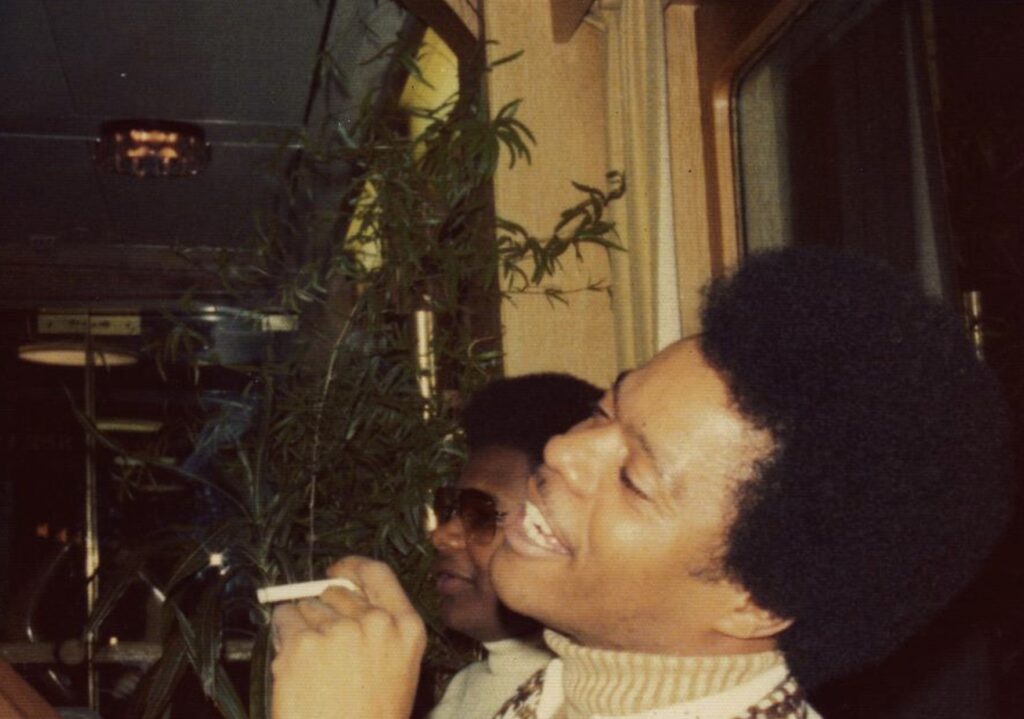 It starts with Papa Dee Allen’s cowbell. Then: All. My. Friends. Know the Low Rider. I know you know this man’s voice, but do you know anything about him? He grew up in Long Beach, CA and as a musician he could pretty much play everything: saxophone, clarinet, flute, piano, guitar. Music was his jam, but not his thing – he’d been all in on sports, and particularly football until an injury changed his trajectory. But he’d been making music too – starting while in college in the early 1960s, he played with a revolving series of jazz, R&B and soul musicians in LA, including recording time as a studio musician with Ray Charles. By the end of the decade he’d coalesced with the core of the crew – himself, Papa Dee, Harold Ray Brown and Howard E. Scott – that would shortly detonate socially as the funk band, War.
Their music was absolutely political, addressing domestic racism, hunger, crime, gangs and turf wars during the period when the (White) counterculture in the U.S. was focusing on the need for peace overseas in Vietnam. In 1975, War released the studio album Why Can’t We Be Friends? with Miller writing and handling lead vocals on Low Rider. Low Rider was laid down in Studio B of Sound City Studios in LA. As the band’s longtime sound engineer, Chris Huston described it, Studio B was a tiny room in which the band would pack more than 30 microphones so that everyone in the crew was in on vocals. Low Rider reached number one on the Billboard R&B singles chart and peaked at number seven on the Hot 100 singles chart. The album went double platinum. Five years later, having moved on from the band and still living in the LA/Hollywood area with his wife and kids, Charles Miller was stabbed to death during a street robbery. No one has ever been arrested or charged for his murder. Video link to his musical masterpiece is right here – nothing wrong with cranking it all day long, today or any day.
*
George Washington Carver (1864 – 1943)
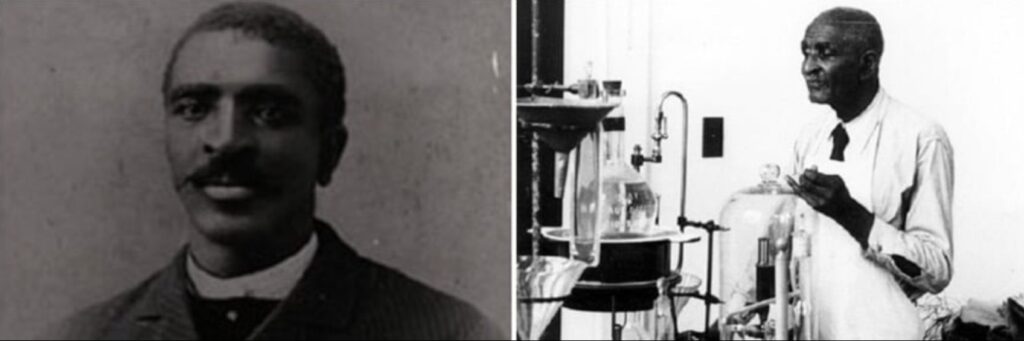 This is how history is made: In 1888, with a $300 loan, George Washington Carver enrolled at Simpson College in Iowa to study art and music. One of his teachers, recognizing his talent for drawing plants and flowers, encouraged him to transfer to Iowa State Agricultural College to study botany. At Iowa State Agricultural College, he got his Bachelor’s Degree (1894) and then continued on to get his Master’s Degree (1896). That same year, Booker T. Washington, the President of the Tuskegee Institute (AL) invited Mr. Carver to head the Institute’s Agriculture Department. Over the almost 50 years that Mr. Carver taught at Tuskegee Institute his focus was on teaching generations of Black students farming techniques that would increase their self-sufficiency. If there is a thumbnail summary of Mr. Carver’s career that makes it into the White history books, it is this: he invented peanut butter. Right? This summary is equivalent to saying Jimi Hendrix decided to play his guitar upside down. It’s not wrong, but it rather misses the point.
George Washington Carver taught composting before it was a thing. He developed a mobile soil lab and classroom to bring what he knew to Black farmers who could use it. He ran the Tuskegee Agricultural Experiment Station and published and distributed the Station’s bulletins and farming brochures for his entire tenure at Tuskegee. He taught cover cropping and crop rotation – alternating years of growing cotton with edible produce – peanuts, soybeans, cowpeas and sweet potatoes – that naturally gather (or ‘fix’) nitrogen from the air to re-nourish and replenish the soil. As a botanist and an agricultural engineer he understood the many ways in which cotton is a thirsty crop that depletes and destroys the soil in which it grows; he made it his mission to find ways for Black farmers – reliant on that cash crop to buy their right to stay on their land – to increase yields in ways that ALSO improved soil quality AND generated alternative farm markets. Mr. Carver played a central role in evolving the deep South from the one-crop/cash-crop land of cotton to multi-crop farmland. In doing so, he played a central role in helping Black farmers – bound into a system of sharecropping that was never intended to open a pathway to choice or to freedom – build profitable markets and better nutrition for/from the range of crops now possible for them to grow. George Washington Carver did this: he turned science directly back toward the community for whom and with whom his mission as a scientist was to serve. See him as a man with a far larger vision than the one that fits into the narrative that you (meaning: you, me, any of us) were handed. Consider that there might have been a reason for the textbook diminishment of this man’s infinite capacity.
*
The National Society of Black Engineers (NSBE)
 We don’t need the data to know it, but we do need the data to show it. Representation matters. Especially so for Black women in engineering. A 2015 study on demographics in engineering concluded that fewer than 1% of all U.S. engineering bachelor’s degrees are awarded to Black women. Without specific focus on the impacts of intersectionality in fields still most commonly characterized by the walking MPY (male, pale, Yale), the results of intersectionality are underrepresentation and absence.
The intersectionality that must be looked at squarely here is this: efforts and programs focused on boosting female enrollment in engineering tend to focus on white women; efforts focused on boosting Black enrollment in engineering tend to focus on Black men. When problems are systemic – as they are in this situation – understanding the why requires taking that wider/broader perspective. Consider this: perception of belonging matters. If you have it, it never occurs to you to doubt it. If you don’t have it – because of a potential myriad of reasons including no professors or advisors who look like you, few or no peers who may share the distinctions of your background, often an intense social transition into an environment in which you are handed the projection baggage of your exceptionalism for simply daring to show up and then told that that weight is yours to carry, sorry/not sorry for the impact that that will have on your ability to move forward on your own personal and professional path – then there is nothing in the current intake process for developing engineering skills that supports your presence in the classroom.
Maybe think about this: engineering doesn’t require some magical, innate talent – that elusive quality that MPY culture holds up as necessary and then can talk you out of believing that you possess unless and until you can figure out how to turn that chatter down – it simply requires hard work. If you want to turn that crank, what could representation look like if Universities scaled back the myth-making around natural ability and scaled up the support for students who have a desire to learn the how. And then – not meaning later, but meaning simultaneously – fix this: with respect to professional salaries for individuals with the same degrees, while white women make 78% of white men’s salaries, Black women make 64%. 64%. Without specific focus on the impacts of intersectionality in fields still most commonly characterized by the walking MPY, the results of intersectionality are underrepresentation and absence.
*
Harry T. Moore (1905-1951) and Harriette V.S. Moore (1902-1952)
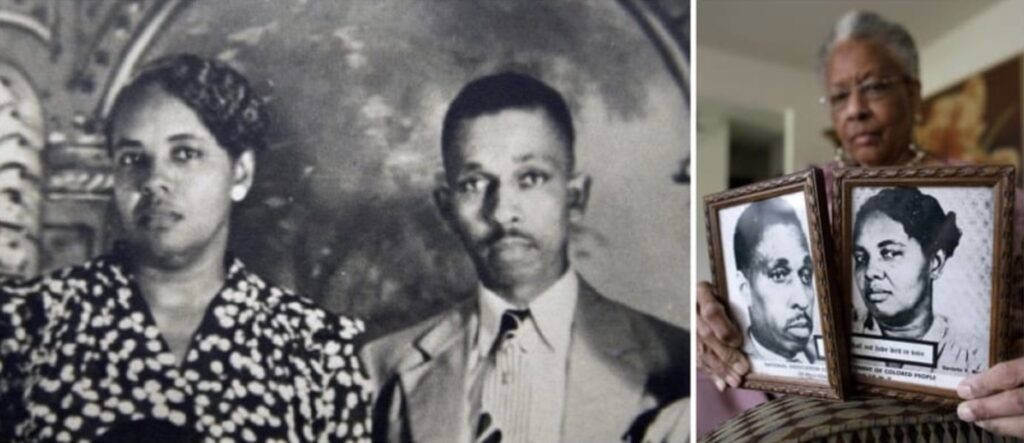
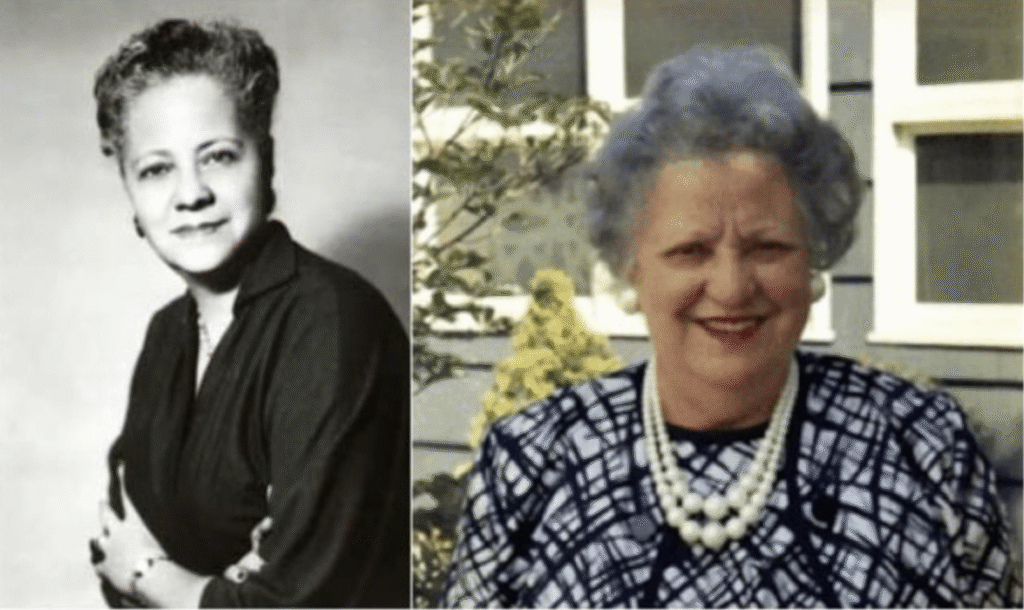
[Harriette V.S. Moore and Harry T. Moore – circa 1930 (L); Evangeline Moore holding photographs of her parents, 2011 (R)]
Location: Mims, Florida. Date: December 25, 1951 Evening hours (EST).Target: Harry and Harriette Moore. Attack type: Bombing. Weapons: Dynamite. Deaths: 2. Victims: Harry T. Moore; Harriette V. Moore. Perpetrators: [White Supremacists]. Motive: Retribution against Harry Moore for his civil rights activities. Litigation: 5 investigations. Charges: None. Convictions: None.
Who were they?
Educators. In 1937, in conjunction with the all-Black Florida State Teacher’s Association, and backed by the NAACP attorney Thurgood Marshall, Harry Moore filed the first lawsuit in the Deep South to equalize Black and white teacher salaries. Although the case was lost in state court, it seeded a dozen other federal lawsuits that eventually led to equalized salaries in Florida.
Organizers. In 1946, both the Moores were fired from their teaching positions by the Brevard County school board in retaliation for starting a local chapter of the NAACP.
Activists. Demonstrating a bravery that is impossible to render here in words, they founded the Progressive Voters League of Florida and traveled the country roads of that rural and deeply racist state to help Black Floridians register to exercise their rights to vote.
Who were they? Parents to two daughters – Juanita Evangeline Moore and Annie Rosalea Moore – one of whom was still living with her parents and survived the bombing that night that turned their parents into martyrs. If you are ever fortunate enough to find yourself in Mims, Florida, take the time to visit the Memorial. In light of where we are politically in the U.S. as well as where the state of Florida stands on the honoring and commitment to teaching of Black history, be intransigent as all h*ll about allowing those in power to somehow paper over the legacy of the Moores.
*
Memphis Sanitation Workers Strike – (February 12, 1968 – April 16, 1968)
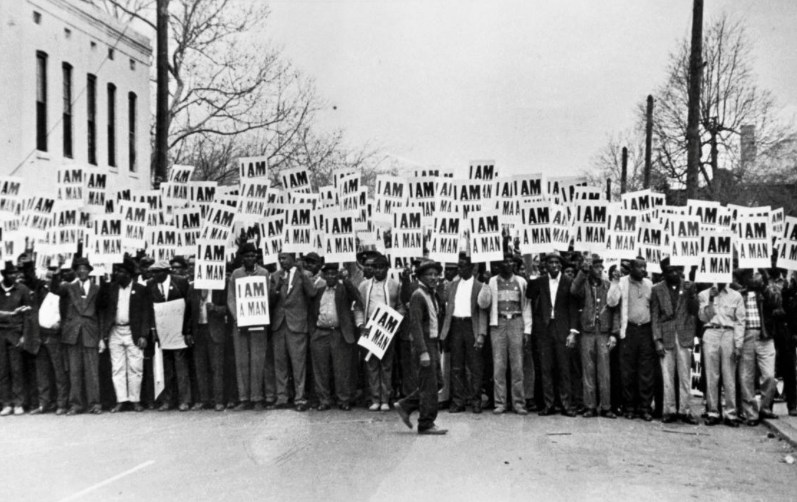 Have you wondered why Memphis? Check the dates there again: why Memphis in April, 1968? Yeah. This strike is why. The Sanitation Workers Strike is why Dr. Martin Luther King, Jr. was in Memphis on that day in April, 1968. On the first of February 1968, two Memphis garbage collectors, Mr. Echol Cole and Mr. Robert Walker, were crushed to death by a malfunctioning truck. Eleven days later, frustrated by the city’s response to this latest event in a long pattern of neglect and abuse of Black city employees, 1,300 Black men from the Memphis Department of Public Works went on strike. Led by garbage-collector-turned-Union-organizer Mr. T. O. Jones, the Memphis Sanitation Workers demanded recognition of their Union, better safety standards, including taking dilapidated trucks out of service, pay for the rainy days when Black workers were told to go home early (and so were not qualified to be paid for their time) and overtime pay when they were forced to work late-night shifts. Sanitation workers in Memphis earned wages so low that many were on welfare and hundreds relied on food stamps to feed their families.
On 11 February, more than 700 workers attended a Union meeting and unanimously decided to strike. On 24 February, 150 local ministers formed Community on the Move for Equality (COME). Under the leadership of Dr. King’s longtime ally, local minister Rev. James Lawson, COME committed to the use of nonviolent civil disobedience to fill Memphis’ jails and bring attention to the plight of the sanitation workers. By early March, local high school and college students were participating in daily marches alongside garbage workers; and over 100 people, including several ministers, had been arrested. On 18 March, Dr. King arrived to address a crowd of 25,000 protestors —the largest indoor gathering the Civil Rights movement had ever seen. “We are all tied in a single garment of destiny’, he preached that day. And in the guise of the mayor, Henry Loeb III, Southern Democratic White Supremacy – walking paternalistically and politely in broad daylight – replied with this: he (Mayor Loeb), believing that he was “the sanitation workers’ keeper”, was “deeply affronted” by the strike and would not abandon his “moral obligation” to protect ‘his’ workers from union officials.
There is a thread of cultural narrative in the cloth that is the United States that goes like this: If Clean = White (teeth, laundry, personifications of innocence), then Black must = {any aspect of the cultural narrative that those who hold power would like not to have to evaluate on any terms other than their own}. It is not an accident or somehow a coincidence that these men in this occupation under these social conditions at (that) time (were) Black. We are a caste-based society too, which means that in the absence of unrelenting and stubborn pushback, cultural narratives have an entirely unsubtle way of perpetuating and reinforcing who is made to embody the caste concept of Untouchable.
*
Black Farmers Discrimination Litigation (formerly known as the Pigford Cases) v Glickman (1999 – 2010).
 April 14, 1999 – a day that Black farmers prevailed. This was the first of two class action lawsuits. The plaintiffs as a class: Black farmers. The defendant as a monolithic entity: The U.S. Department of Agriculture (USDA). The basis of the lawsuit: the claim that the USDA had systematically discriminated against Black farmers on the basis of race and categorically failed to respond to complaints alleging racism over the 15 year period prior to the first lawsuit’s filing. The structure of power in this case look(ed) like this: farm assistance in the form of loans, tax relief and debt forgiveness are guaranteed on the Federal level but are administered on the local (county) level. Black farmers, filing suit in class action, argued that they were not receiving fair treatment when they applied to local county committees for assistance in the form of crop payments and disaster payments and were not being treated equally with respect to access to farm loans. Regarding farm loans, Black farmers argued that relative to white farmers, they were being denied loans at a higher rate and were being forced to wait longer for loan approval when those approvals did come. The combination of these behaviors, they argued, represent(ed) systemic racial bias in the administration of Federal USDA funding. In addition, that the USDA had closed its Civil Rights Office in the decade preceding (1983) compounded this bias by creating a structural inability for Black farmers to seek redress on a level higher than the local county committees.
A 1994 study commissioned to evaluate claims of racial bias in provision of farm assistance concluded that the largest USDA loans went to corporations (65% of the loans); for the remaining 35% of the farm assistance loans provided, 70% of that remaining available pot of money went to white male farmers. The USDA had argued that the distribution of assistance in the form of crop payments and disaster payments was proportional to presence in the industry: Of the more than 2 million farms operating in the United States, roughly 45,000 or around 2% are operated by Black farmers and the national average annual market value for farms owned and operated by Black farmers was – at the time of the lawsuits – only roughly 20% of the average annual market value for White farmers ($30,000 versus $140,000). Following the Holy Racist Grail template of ‘let’s assume all else is equal in how resources are accessed and apportioned and we’ve all punched GO! at exactly the same time on a playing field known for its historical levelness’, the USDA initially argued that minority farmers – through receiving roughly 10% of available loans (100% – 65% – [0.7*35%]) were receiving a portion of the loans that exceeded their proportional representation in the industry. Setting aside (somehow) the USDA’s categorization of farming as an industry and the fact that ## of loans does not equal value of loans and….yeah. right. see? Own up, USDA, and start paying Black farmers what they’re owed.
Ultimately over $1B in kind was to have been made available to Black farmers in the form of cash payments, tax reimbursements and debt relief. In addition, and importantly – in explicit recognition of how slowly Federal wheels can turn – the U.S. government had agreed, as a condition of the settlement, that a moratorium must be placed on the foreclosure of claimants’ farms during the protracted process of class action claim review. In 2022, with a financial settlement with respect to these class action claims having been reached and funds ensured to begin ever so slowly moving in the direction they should, claims of discrimination by white farmers with their knickers in a twist resulted in the law – designed to ever so slightly shim that catastrophic abomination of a historical imbalance – being declared unconstitutional. What? Yeah. Sit with that for a moment. There is no carpet thick enough to be unrolled over U.S. history to create a smooth and easy walking sort of now. History doesn’t work that way. We shouldn’t either.
*
Fannie Lou Hamer (1917 – 1977)
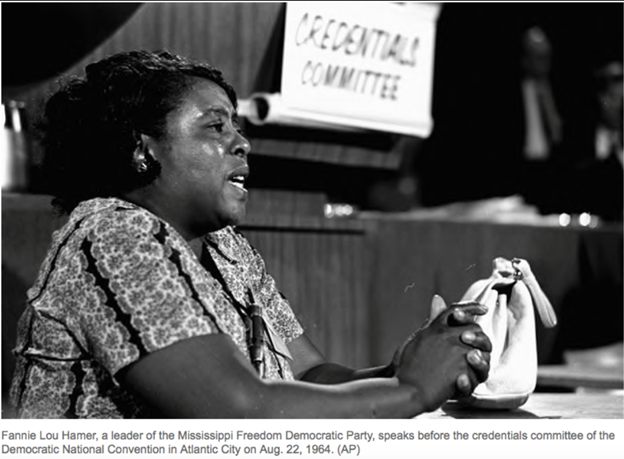 In 1964 – in direct challenge to the Mississippi Democratic Party’s all-white segregationist delegation, Fannie Lou Hamer co-founded the Mississippi Freedom Democratic Party (MFDP) and went to the Democratic National Convention demanding that the MFDP be recognized as state’s official delegation. To claim that recognition, Ms. Hamer took her seat at the microphone, faced the National Convention Credentials Committee, and spoke. The audio of her testimony that day is here. If you plan to listen, take a seat and give it your full attention. Her memory and what she endured and accomplished deserves no less. Her power as an activist was already recognized by 1964 – knowing that her testimony before the Credential Committee was to be broadcast, President Lyndon Johnson scheduled an impromptu televised press conference so that the national television networks could not cover her testimony live. Suffice to say it didn’t matter – that night, Mrs. Hamer – sitting in her hotel room – got to watch her testimony broadcast in prime time on the evening news. Suffice to say too that it worked: by 1968, her vision for racial parity in state delegations had become a reality and she – who President Johnson had called ‘that illiterate woman’ – was a member of Mississippi’s first integrated delegation.
One on-line biography of Mrs. Hamer begins with this: “Fannie Lou Hamer walked with a limp and still had a blood clot behind her eye from being severely beaten by police in a Mississippi jail. She was the youngest of 20 children born to sharecroppers in Mississippi, where she had spent much of her life picking cotton until she was fired for trying to register to vote.” Why had she been taken to that Mississippi jail? Returning by bus from a voter registration workshop in South Carolina, she and 5 other workshop participants stopped at a rest stop in Winona, MS and tried to order lunch at the counter. This was 1963. Was it perfectly legal in 1963 for Mrs. Hamer and the other workshop participants to request service at that highway rest stop? Yes it was. Did the highway patrol officer arrest them anyway? Yes he did.
*
The Marching 100. (Past, present and future).
 All right. There are marching bands and then there are MARCHING BANDS. Feel free to argue me on this one, but my opinion won’t change. Score marching bands on a scale of 1-10 and it’ll go like this: you and your band (and by you, I mean you, me and any of us white folks who were ever in marching band) stepping out some nifty formation to Birdland or some such number: Score = (-1). The Florida A&M University (FAMU) Marching 100 before they even take the field at halftime? Score = 11. Yup. Just warming up. Then shift your scale to 100 when they start cranking. Wha???? Yeah. That’s right. Even the tubas. Feel free to have no need to compete ever: The Marching 100 have already won. I’m gonna assume it’s not just those of us who got to watch The Marching 100 up close growing up who feel this way, but talk about having the scale slid so smoooth right out from under you that you’re just like, no, yeah, all good, please, carry on – I’m just gonna go over here (waving vaguely toward the sidelines). And put my flute or whatever away. And do absolutely nothing more than just shout.it.out.loud to their greatness. If you have no idea what I’m talking about, that’s ok. That’s what the interwebz are for. It’s a marching band kind of day around here today. In fact, it’s a marching band kind of day every day around here. Go Rattlers.
*
Eatonville, FL (incorporated 1887)
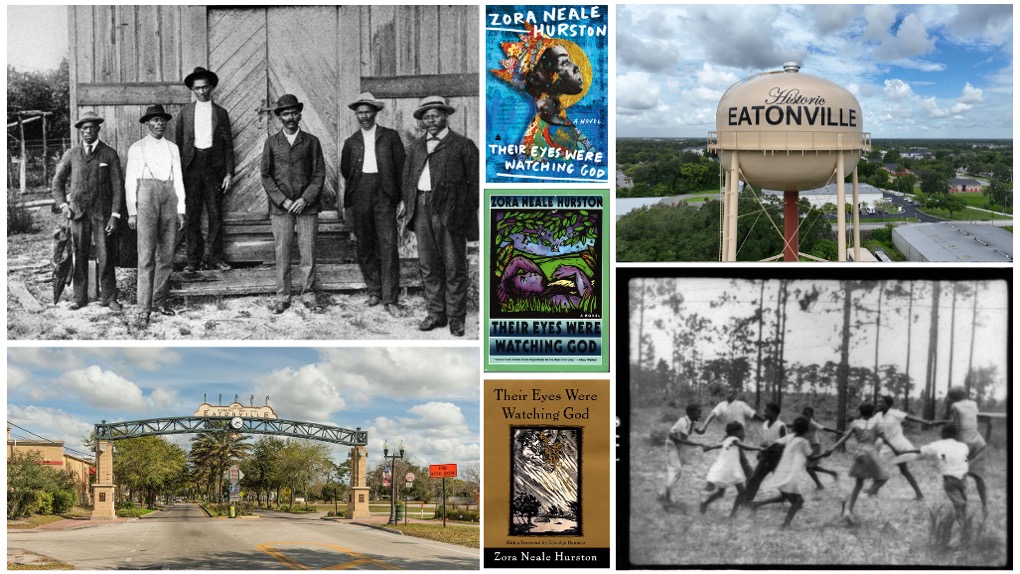 Eatonville, FL was/is/will always be the first planned, self-governing, all-Black municipality in the United States. For context, in the 35 years between the end of the Civil War and 1900, approximately 400 black towns, settlements, and enclaves were formed, with about 1/3 of them becoming legally-recognized municipalities. Eatonville was first. Zora Neal Hurston, who grew up in Eatonville after moving from Alabama with her family in 1894 – she 3 years old and the incorporated town, at the time, itself only 7 – later described her childhood home like this: “a city of five lakes, three croquet courts, three hundred brown skins, three hundred good swimmers, plenty guavas, two schools and no jailhouse.”
Twenty two years after the end of the Civil War and during that brief period of legal and political opening that followed, Eatonville was founded by a recently emancipated Black man, Mr. Joseph C. Clarke. With the backing of two former Union Army officers (one named Josiah Eaton who had previously acquired the land and for whom the town was named), and in a climate in which the majority of local white landowners were unwilling to sell land to Black men, Mr. Clarke bought 100+ acres in central Florida. Parceling the land to Black families who had come to this area in the decade preceding to farm, plant citrus, and build the infrastructure for the newly established town of Maitland, Eatonville offered low land prices, an easy climate, and the ability to own, work, farm, and tend your own precious and private land, that last part so nice I’m gonna write it a second time: the ability to own, work, farm, and tend your own precious and private land. “Maitland is Maitland until it gets to Hurst’s corner”, wrote Zora Neale Hurston, in her 1937 novel, Their Eyes Were Watching God, “but then it is Eatonville.”
On August 15, 1887, twenty-seven newly registered Black voters stated their intention to create a municipality. To be built on a foundation of family, faith and education, Eatonville was formally incorporated. The town’s newly elected leaders: Columbus H. Boger as mayor and Joe Clarks, Matthew Brazell, David Yelder, E.L. Horn, and E.J. Shines as aldermen. The first religious institution in Eatonville was the St. Lawrence African Methodist Episcopal Church, then simply called the Methodist Church (1881). St. Lawrence A.M.E. still stands in Eatonville and serves the community to this day. The first school in the community was the Hungerford Normal and Industrial School (1889). Named for a physician who taught reading and writing to any and all and died in fighting an outbreak of scarlet fever, the school’s first administrators – Russell C. and Mary Calhoun – came from the Tuskegee Institute in Alabama to lead. By 1935, the Hungerford School was the premier institution for Black education in central Florida. The Hungerford School initially taught life skills in the trade school tradition: farming, gardening, animal husbandry, food preparation and preservation, blacksmithing, mechanical repair, and technical drawing, The School was privately run until the 1950s and then was handed by the Courts to the County as a public trust. Renamed the Wymore Career Education Center, this historical institution closed its doors in 2009.
Find Eatonville – current population ~ 2300 – on a map: a national historic district now, the designation a bulwark again the relentless progress of the greater Orlando metropolis, voraciously swallowing its surrounding everything as it grows, and maybe ask yourself this: in 1965, when 27,400 acres of nearby land was purchased from local landowners for a price tag of $5 million, why there? I don’t have an answer to this question beyond what any can surmise, but holy h*ll, how hard is that trying to go about your own d*mn business with that all looming in the background?
*
Septima Poinsette Clark (1898 – 1987)
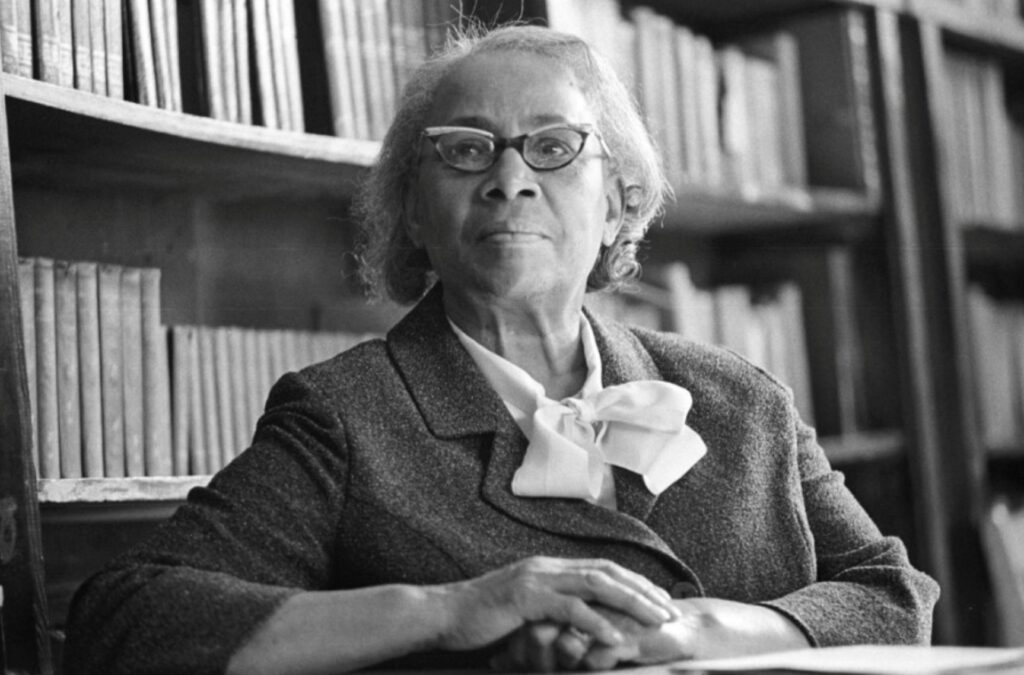 The Mother of the Movement. A teacher through and through, Septima Poinsette Clark was a leader in grassroots citizen education and played a central role in developing the literacy and citizenship workshops (Citizenship Schools) that were the backbone of the Civil Rights Movement. Graduating from secondary school in 1916, she took and passed the teacher’s exam in South Carolina, and for more than 30 years taught at Black schools in that state. Barred by White Supremacy from teaching in the Charleston public school system, she taught in rural districts, and while educating children during the day, she also quietly and persistently taught literacy to adults at night. During this time she developed innovative methods for rapidly teaching reading and writing, employing everyday familiar materials like the Sears catalog. Over the years and during summer recess from teaching youngsters, she earned her B.A. (Benedict College) and M.A. (Hampton Institute). In 1956, South Carolina passed a statute that prohibited city and state employees from belonging to civil rights organizations. When – after 40 years of teaching – Mrs. Clark refused to resign from the NAACP, the Charleston City School Board terminated her contract.
Believing deeply that literacy means liberation, she was already at this point well known across the South for her grassroots educational efforts around voter registration and civil rights. Rosa Parks – just months prior to helping launch the 1955 bus boycott in Montgomery, AL, had participated in one of Mrs Clark’s workshops. In 1961, when the state of Tennessee forced the closure of the Highlander Folk School at which she had been teaching these workshops, Septima Poinsette Clark was hired by the Southern Christian Leadership Conference (SCLC). At SCLC, Mrs Clark became the director of teacher training and education and established the Citizenship Education Program (CEP). In 1975 she ran for and was elected to the Charleston, South Carolina, School Board, the same Board that 19 years earlier had fired her for walking out into her days with the belief that our rights as individuals are not up for negotiation by our employers. The following year, she fought for and won the reinstatement of her teacher’s pension, including back pay for those missing years, and a concession from the governor’s office that her firing 20 years earlier had been unwarranted. It is very important here to not lose sight of the fact that it took court action on her part to force a declaration that her firing had not just been unwarranted, but had been, in fact, illegal. The concession matters, of course. But the remuneration for what was rightfully hers matters more.
*
Matthew Henson (1866 – 1955)
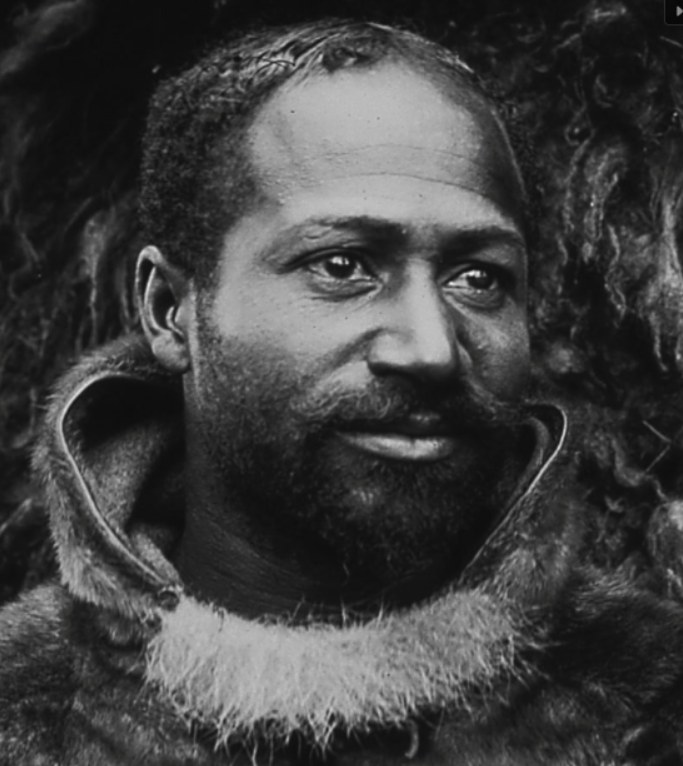 The Explorer. Where do we first hear someone’s name and what it is that they’ve accomplished? For me, with respect to Matthew Henson, it started like this: For a time in the early 1990s I lived in New Bedford, MA and worked on a piece of history still full to life, the 1890’s-built Grand Banks fishing schooner, Ernestina. Ernestina’s original name was the Effie M. Morrissey – the name of the daughter of the ship’s first captain. Before the ship came ultimately back to MA in the 1970s, Effie Morrissey/Ernestina did many things, including running for a time between Cape Verde and New England as a packet schooner; Ernestina was the daughter of Enrique Mendes, the Cape Verdean gentleman who was the ship’s last private Captain. With the Ernestina, Captain Mendes did 14 trans-Atlantic round-trip voyages, bringing immigrants from Cape Verde to New England and carrying supplies back home on the return. He did it all the old way – under sail and without modern electronic navigation. Under Captain Mendes, Ernestina was the last U.S. sailing immigrant vessel.
In the 1920-1930s, the Morrissey had served in Arctic exploration under the command of a Newfoundlander, Bob Bartlett. Prior to this command, Captain Bartlett had run the SS Roosevelt and had accompanied United States Navy Commander Robert Peary on his attempts to reach the North Pole. Through the ice, Captain Bartlett had navigated the Roosevelt to within 150 miles of the Pole and then was told by Commander Peary that he would not be accompanying the overland party on the final on-foot exploratory trek to 90 N. The navigator who Commander Peary trusted more than anyone in the world for that final slog: a man on the crew named Matthew Henson. Matthew Alexander Henson, the son of two freeborn Black sharecroppers in Charles County, MD, was one of the team of 6 – himself, Peary and four Inuit guides – who, in April 1909, may have been the first party to reach the North Pole.
As a child, Mr. Henson had left home to find work on boats at age 12; his first position having been attained after walking to Baltimore and hiring himself on as a cabin boy. The Captain of his first ship – the Katie Hines – taught him seamanship and took him round the world. In 1887, the Captain of the Hines having died and Mr. Henson now working in a shop in Washington D.C., he met Robert Edwin Peary, an explorer and officer in the U.S. Navy Corps of Civil Engineers. Peary was impressed by Mr. Henson’s seafaring knowledge and skills and hired him initially as his valet. Ultimately, Matthew Henson would sail on eight arctic expeditions over 22 years. Working with Inuit guides, he became an accomplished interpreter. Preferring Inuit practical wisdom to the Great White Explorers’ where-is-my-Scotch-and-should-we-bring-snowshows-for-the-ponies too?-flail-about-and-suffer show, he became an accomplished high latitude navigator. When Peary and his team finally reached the North Pole in 1909, it was Mr. Henson who planted the flag. Mr. Henson died in 1955; twenty years later, at the request of Dr. S. Allen Counter of Harvard University and with Mr. Henson’s family present, the U.S. Government granted permission for his, and his wife, Lucy Ross Henson’s, remains to be exhumed and re-interred at Arlington National Cemetery.
There are many aspects of the Age of (White) Exploration that are deeply problematic (including the granting of 1sts to folks-from-away who haul themselves to crosshatches of geography that local residents already know full well are there but don’t burn time and calories trekking to because what’s the point if they don’t offer much in the way of nourishment to body and spirit?), but honor and credit here need to be given/taken/placed where honor and credit are due: Matthew Alexander Henson deserved and received the Hero’s Burial for the work he did to stand at 90 N. He planted one hell of a flag.
*
Ebenezer Baptist Church (Atlanta, GA)
 In 1886, nine years after the end of Reconstruction – that period of a dozen years after the end of the Civil War in which attempts were made, first, to address the political, social, and economic legacies of Black human enslavement and, second, to determine how to readmit those 11 states to the Union that had seceded at or before the declaration of war – Rev. John A. Parker – a freedman – and an initial congregation of thirteen souls, founded Ebenezer Baptist Church. Airline Street, McGruder Street, Bell and Gilmer, Auburn Avenue, Edgewood for a time in 1918 while the Auburn Avenue sanctuary was being built up, the home of God being human spirit, after all, and every bit as present in that Edgewood storefront as shining out from Sweet Auburn. The roll of ministers called to pastor at Ebenezer Baptist Church stretches from Rev. Parker to and through Rev. Raphael Warnock – he, also, as of January 20, 2021, now a United States Senator and the first Black senator to represent the state of Georgia.
Take one step back a moment now to let that larger picture in – that view that both cannot be and absolutely is – and pause with this and see: History draws its arc along the greatest of the Great Circle routes: The Reverend Raphael Gamaliel Warnock is the first Black Democrat to be elected to the Senate from the Deep South since Reconstruction.
Along that line from Rev. Parker to and through Rev. Warnock, Ebenezer Baptist has been led by only three other senior pastors: Rev. Adam Daniel Williams, Rev. Martin Luther King, Sr., and Rev. Dr. Joseph L. Roberts, Jr. The Rev. King Sr. served as senior pastor for more than 40 years and through that arc of his calling he shared the pulpit as a father with his sons: first, the Rev. Dr. Martin Luther King, Jr.. When Dr. King Jr. was murdered in Memphis, TN, his presence there that day in April 1968 in support of Black sanitation workers who’d risen up to strike non-violently in protest of their treatment by the city of Memphis, his place as co-pastor with his father was taken up by his brother, Rev. Alfred Daniel Williams King. Across multiple generations and along many conduits bound toward God, there is legacy within legacy in this congregation and its spiritual leaders. From an initial following of thirteen, Ebenezer Baptist now serves a congregation of more than 6,000. The name itself means ‘stone of help’ and for 139 years now, Ebenezer Baptist has been a foundation for Black community power and organizing in the fight for fair housing, equal employment access and civil rights. This is the social gospel, the arc of which – as all pastors at Ebenezer Baptist have preached – bends slowly and inexorably toward justice.
On July 30, 2020, the memorial service for the late GA Rep. John Lewis – the great man who former President Barack Obama eulogized that day as “a man of pure joy and unbreakable perseverance” was held at Ebenezer Baptist. May you Rest always in Power and in Glory, Representative Lewis. It is as important now as it has always been: know who your heroes are.
*
Allen Quinn Jones, Sr. (1893–1997)
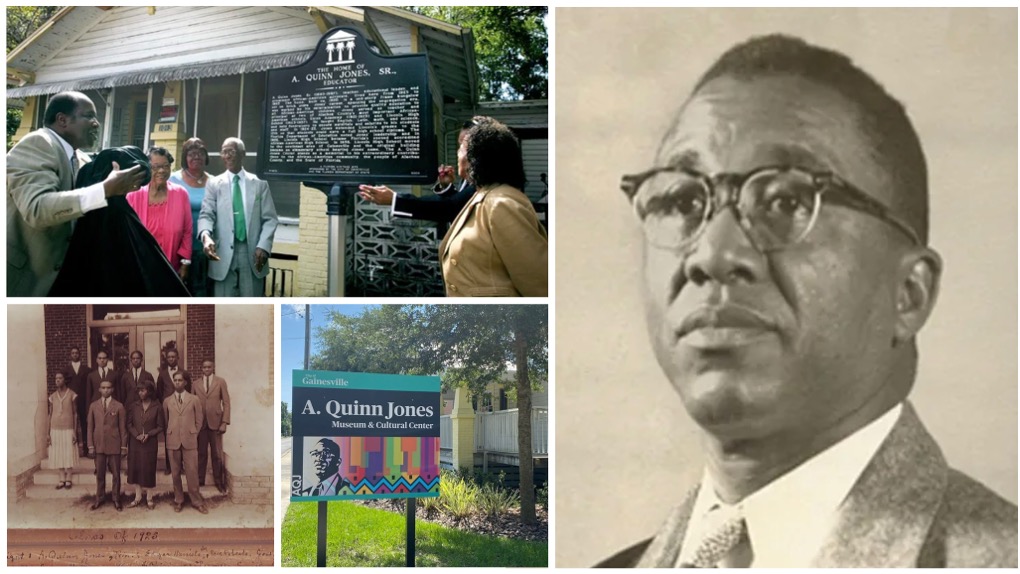 Maybe this starts with what he built first: the 2nd fully accredited African-American high school in the state of Florida. Or who he was: Professor Jones. Or what he also built: the stature and the legacy of Lincoln High School and its graduates over decades of the 20th century. Or who he also was: the first principal of Big Red and a teacher there twice over for 40+ years. His house in Gainesville still stands and is honored on the National Register of Historic Places (NRHP reference No. 09001278; Categorization/ Areas of Significance: BLACK EDUCATION; Periods of Significance: 1925 – 1974.)
How it began: 1921 – a letter to the President of Florida A&M looking for an educator to work in Gainesville. The reason for the need: a 1920 bond issue passed by the city for the construction of two new high schools: one for white students and one for black students. Both were to be built of brick, both of similar size, and both with similar features.
The response: a recommendation from the A&M President to offer the position to Mr. Allen Quinn Jones, “a graduate of this institute (B.S. 1915) [who] has considerable experience in teaching and (is) a man of excellent character.” Subsequently hired, in 1922, Mr. Jones joined the staff of Union Academy as Principal. By 1923, the school, with Jones as its leader and guide, had moved to a new building, now teaching both elementary and high school grades and becoming the first African-American high school in Alachua County. As constructed and newly named, Lincoln High School was two-story and red brick and opened onto a large parcel of property that lacked both landscaping and sidewalks. Students and teachers took on the landscaping, and Jones, securing left over bricks from another construction project, encouraged the city to complete the job as promised. Until a cafeteria was built more than 30 years later (1955), parents of Lincoln students brought prepared food to the school for those who lived too far to walk home for lunch.
In 1925, Lincoln High graduated its first class of 12th-year students and in 1926, under A. Quinn Jones leadership, Lincoln High became the second accredited Black high school in Florida to offer an education through the 12th-grade.
As an individual, Jones continued his own pursuit of excellence. During the years he taught in Gainesville, he earned two Master’s degrees (Oskaloosa College and Hampton Institute) and undertook course work toward a PhD (New York University). During academic breaks at Lincoln High, he taught in Tallahassee (Florida A&M) and Daytona Beach (Bethune-Cookman). As an educator, his subjects were math, science, language arts and Latin, and throughout much of his career, he also trained and supported many of the state’s future Black teachers. Stepping down from teaching in 1945, he continued to serve as Lincoln’s Principal for another decade, shepherding Big Red’s students and her legacy through into a newly constructed school in a newly constructed legal era. Professor Jones retired in 1956 and the old school, still standing now on 7th Avenue in Gainesville and still in service to the community, was re-named in his honor. The new school, built in SE G’ville near the Waterworks, still stands too.
A. Quinn Jones was a resident of Gainesville for 75+ years, living for most of those years with his wife “Freddie” Jones (1903 – 1992) in the 7th Avenue bungalow that now sits on the Historic Register. Together they raised 4 children. Frederica “Freddie” Marie Copper Jones was an educator too (BS 1931; MS 1954 – Florida A&M), teaching at Lincoln High through into the 1960s, as well as an accomplished and classically trained pianist. Longtime members of the Greater Bethel AME Church in Gainesville and teachers to their core, the Jones’ served as teacher (“Freddie”) and Superintendent (A. Quinn) of the Greater Bethel AME Church Sunday School. During Sunday service, “Freddie” played the organ.
[And personally, these pieces that didn’t come together into anything like a glimpse of an entirety for me until some years after I graduated from Lincoln Middle School and then Buchholz High School, and then little by little, that slow growing seedleaf of understanding unfurled:
why…? (because it used to be a high school)
why…? (because I’m quite sure he was a teacher or an administrator at Lincoln High, or both; he would have lost his job when ‘in all due haste’ the State mandated its mid-semester closure in February 1970 in final legally-forced compliance with the 1954 law)
where…? (see above)
and…? (see above)]
*
Ming Smith + Anthony Barbosa + Albert R. Fennar + Ray Francis + Herbert Randall + C. Daniel Dawson + Beuford Smith + Herb Robinson + Adger Cowans + Herman Howard + James Mannas Jr + Louis Draper + Calvin Wilson + Shawn Walker = Kamoinge Workshop
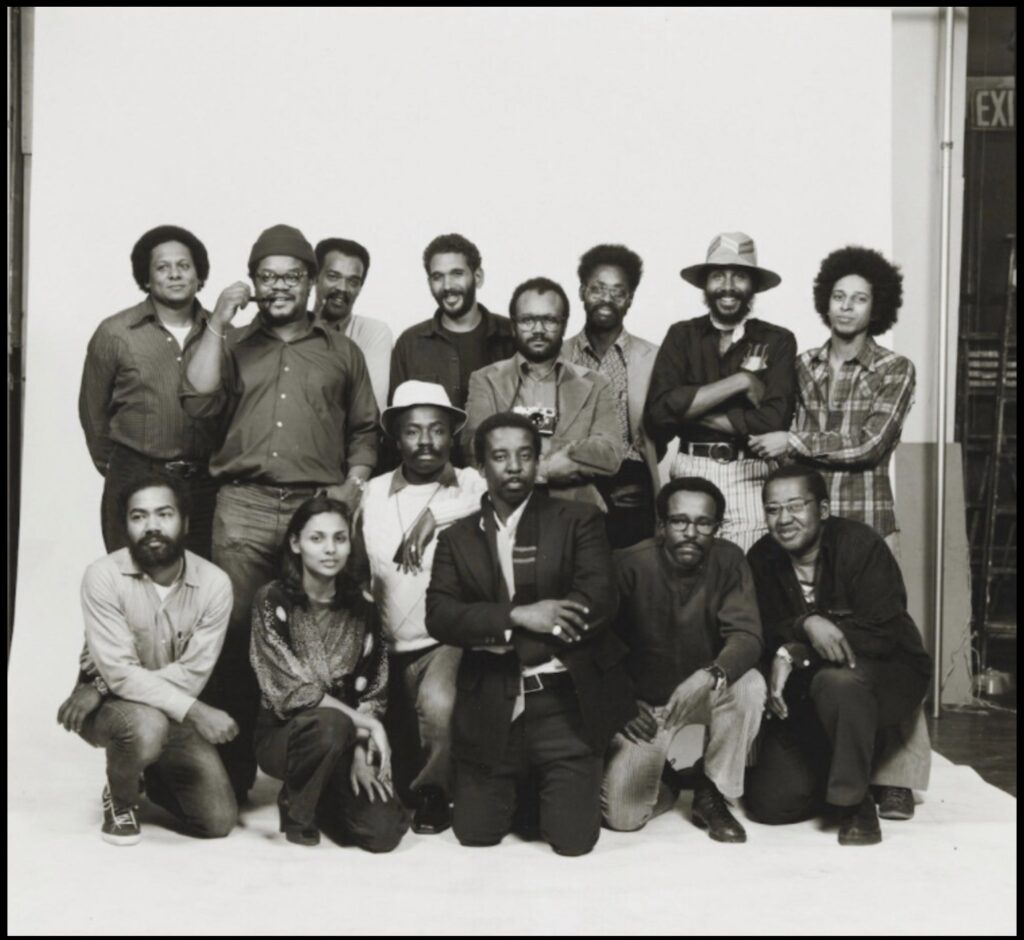 They came together in Harlem in the early 1960s – a group of photographers who met to talk shop, critique each other’s work and, as Adger Cowans described that coalescing of talent that became Kamoinge, “to take beautiful pictures of our people”. Their work – individually and as a collective – was a direct and simple reframing of the relentless broader (read: White) cultural imaging of the Black experience – perennially angled in the press so that only poverty, violence and superstars seem(ed) to catch the light. One way to appreciate the substance and the style of the photographers who formed the collective is to start with their individual bodies of work and dive deep into the connections. One place to start is here: The Black Photographers Annual, Volume One (1973) through Volume Four (1980): [LINK] Begin with Toni Morrison’s Foreword in Volume One and her gorgeous praise. The majority of the editorial staff for the Annuals were members of Kamoinge and their goal with the Annuals: to provide outlets and exposure for artists who broader (read: White) culture could not countenance the defining of aesthetics and perspectives on their own terms. If not making work wasn’t an option (and it wasn’t), what was the solution? Go your own way.
It took until 2020 for the Workshop’s creative output to be shown at the Whitney Museum of American Art in New York City and if this public celebration of Kamoinge feels any larger portion of ‘isn’t this wonderful?’ than ‘it’s about d*mn time’, consider this: in the here-and-now, fully 50+ years after the first volume of the Annual dropped, fewer than 2% of artists in major U.S. museum collections are Black. Still. And this: fewer than 6% of artists represented by major U.S. galleries are Black. Still. White sees white. Incident light: Black-led arts publications and Black-led arts organizations are fundamental and necessary to create, sustain and amplify access for Black vision and Black expression. Still.
In exploring the work of each member of Kamoinge, perhaps start with Ming Smith [LINK] – the only woman in the original Workshop and the first Black female photographer (1979) with work in the collection of the Museum of Modern Art. She’d originally submitted her work to the MOMA in response to an open call, having been told as a young woman that the only things to “do” with a photography degree were machinery or medical (specimen) studies. As she described it, the experience of having her work selected for the MOMA was so affirming for both herself and her family that years later, when her father was passing, all she had to say to him was ‘Museum of Modern Art’ and he would smile. Reflected light. Sit for a moment in that radiance. Here is the LINK to the Whitney Museum of American Art exhibition of their work.
*
1968 (1968)
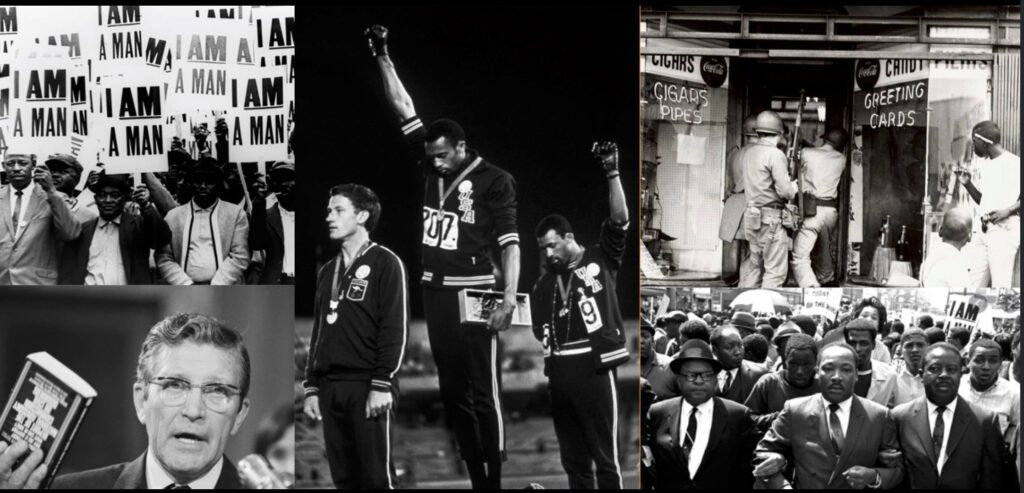 Parallax (noun): the effect whereby the position or direction of an object appears to differ when viewed from different perspectives. Put simply: when you stand to one side of an object and it looks small and off-center, but then you move to the other side of the object and it looks both larger and centered. In 1967, following the riots that had boiled over righteous anger in U.S. cities as the result of the national unwillingness to directly address and redress structural and systemic racial discrimination, then President Lyndon Johnson (LBJ), convened a commission to study what the h*ll was going on. The appointed commission consisted of 11 members, only two of whom were Black and none of whom operated even remotely near the edge of that 1960s establishment circle. With these pillars of the Establishment chosen to speak on behalf of U.S. Black citizenry, Black Power advocates were convinced that the National Advisory Commission on Civil Disorders—as the commission was officially named—would sanitize America’s ugly racial realities and use the Report as a congratulatory rubber-stamping of LBJ’s Great Society social initiatives. Instead, when the Report dropped in February 1968, an infuriated LBJ canceled the White House ceremony in which he’d been scheduled to accept a bound copy of the Report and refused to either comment publicly on the document or sign customary letters thanking the commissioners for their service. The Report’s conclusion (using the terminology of the time as it was written): “What white Americans have never fully understood—but what the Negro can never forget—is that white society is deeply implicated in the ghetto. White institutions created it, white institutions maintain it, and white society condones it. Our Nation is moving toward two societies, one black, one white—separate and unequal.” Moreover, wrote the Commission, “Almost invariably, the incident that ignites disorder arises from police action.”
The Commission could not have stated this more plainly: police brutality is a taproot of both the alienation and the anger within Black communities. In addition to its direct naming of systemic white racism and violent policing (including recognizing that these terms are significantly synonymous) as causes of the previous year’s riots, the Report promoted an ambitious policy agenda, including major programs in education, employment, housing, and welfare. What the Kerner Commission Report got exactly right was this: focus on the structural obstacles confronting Black communities, rather than on the ‘supposed personal failings’ of individuals who riot. Parallax. Shift your frame of reference to understand that the structure is the problem and the riot is – if not the solution – then an inevitable response to inequality, brutality, lack of access and discrimination. If you were in the same position, you would respond in the same way.
To understand what happened next, one way to think about 1968 is like this:
Tet Offensive – Vietnam War – January – September
Memphis Sanitation Workers Strike – February – April
RELEASE OF KERNER REPORT – February 29
My Lai Massacre (Vietnam) – March 16
Assassination of Rev. Dr. Martin Luther King, Jr. – April 4
French Workers Strikes and Riots – the month of May
Assassination of Robert Kennedy – June 6
USSR sends tanks into Prague – August 20
Protests at the Democratic National Convention – August 28
Mexico City Olympics – October 16
Nixon Presidential Election – November 5
Whitey (Apollo 8 ) circles the moon – December 24
Nixon declares the Kerner Commission Report ‘too permissive’ and goes full law & order in his Presidential Platform – The next 4 years.
Based on this response, it’s a solid dollars-to-donuts bet that Nixon never cracked open the Report or cared to understand its findings. Parallax. 55+ years later, here we still are. We can’t be surprised.
*
The Sit-In Movement (1960)
 Ancient history now, I know, right? – all the way back there 65 years ago – but what these young people set into motion remains deeply inspiring. Legally, this was the marvel of the Sit-In Movement: a full 15 years after Brown v. Board of Education (1954) – the Supreme Court ruling that segregation of public schools was unConstitutional – integration was STILL being resisted by States. In this period (post-Brown ruling, but while many states were refusing to comply with both the letter and the spirit of the Law) – while most courts were consistently rejecting claims that the Constitution ALSO prohibited operators of private businesses from legally discriminating based on race, the Sit-In Movement quietly, persistently and stubbornly showed the world what momentum in the service of justice looks like.
This is how they began: On the afternoon of Monday, February 1, 1960, four students from the Agricultural and Technical College in Greensboro, NC, sat down at the lunch counter of the local Woolworth store and asked to be served. The Greensboro Woolworth, like most department stores in the South, had a policy of serving only White people at the lunch counter. Refused service, the four students sat quietly in their seats until closing. The following morning the students returned to the lunch counter, this time with sixteen friends. Again they were refused service, and again they remained seated in silent protest. The next day, the students returned and occupied all forty seats at the Woolworth’s counter. By the end of the week, an estimated two hundred students were taking part in the protest.
Quietly, persistently, and stubbornly they held their ground as White people sh*t hit the fan around them: Confederate flag waving escalated to taunting escalated to bomb threats and in subsequent cities in which the Greensboro spark kindled fire, escalated all the way to physical violence and riots. On February 8, Black students sat in at lunch counters in Durham and Winston-Salem, NC and on the next day there were protests in Charlotte and Raleigh. On February 11, Hampton, VA, became the first city outside NC to join the movement. The following day, 100 protesters took part in a demonstration in Rock Hill, SC. The Sit-Ins hit the national news. Students in Nashville, TN and Tallahassee, FL were next and upon being arrested and charged, they found a way to expand their protest: choosing to serve jail sentences rather than paying a fine. By the end of February, thirty cities in seven states had Sit-In demonstrations. By the end of Spring, Sit-Ins had taken place in all thirteen southern states and involved 50,000+ protestors. Slowly, slowly, city-by-city what these Black students bravely and stubbornly set into motion began to roll forward. This is momentum toward justice and why would you, me or anyone do anything other than lean full on in to keep it rolling forward?
*